
For someone who feared health struggles would keep him out of college, Curtis Faughnan ’26 made the most of his four years at Wabash.
The Brownsburg, Indiana, native had serious dietary restrictions that made the idea of communal living and eating a challenging one. Nearly every social interaction seems to involve food. Health-related anxiety made the challenges worse.
But Faughnan reached commencement with lifelong relationships established, a full-time job already started, and newfound confidence in navigating life’s complications.
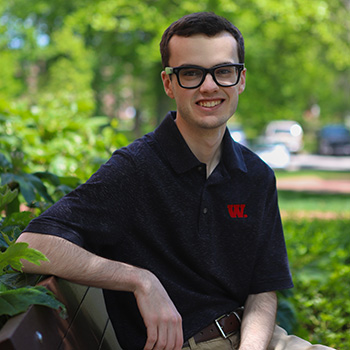 Associate Professor of Art Matthew Weedman said, “He’s the biggest fastest success story we have had come through the art department in my time here.”
Weedman spoke enthusiastically about Faughnan’s earning Distinction in his Art comprehensive exams, publishing a comic book for his senior art exhibition work, and starting work at an Indianapolis company before the school year ended.
Faughnan’s classmates are equally enthusiastic when asked about him.
“He’s probably one of the best friends that I made at Wabash,” said Ethan Gonzales ’26. “He’s done great things and will continue to do great things.”
Assistant Director of Admissions Evan Furuness ’26 agrees. He has known Faughnan since middle school and has seen him overcome challenges and become more outspoken.
“He’s pretty soft-spoken, which is the opposite of me,” Furuness said. “Our art, our ways of approaching art, and our philosophies on art, couldn’t be more different, so it’s always interesting having Curtis in the conversation.
“This senior art class really brought Curtis out of his shell and forced him to be part of this group, voice his opinions, and critique our stuff. It was definitely a fun semester.”
Faughnan’s two majors, computer science and art, might seem extremely different from each other. The computer science world encourages the use of artificial intelligence, while many artists shy away from AI. And yet, Faughnan not only embraces AI in his personal life, he is also working in that world.
Faughnan started his role as a developer/technician at EchoTech.ai before graduation, programming wheelchairs using AI to provide finetuned control and more effortless use.
“We’re dealing with AI wheelchairs,” Faughnan explained. “People who only have control from the neck up have to control about 40 different buttons with their head, so their neck gets tired, to go through a doorway. We wanted to make it a little bit easier, so we use AI to control the chair.”
As part of his job, Faughnan trains the chair how to maneuver.
“It’ll drive straight, and then if they want to go right, all they do is just hit right once, and it’ll make the turn through a doorway and navigate through hallways. It’s pretty cool.”
Faughnan emphasizes that artificial intelligence is not only making life for wheelchair users easier—it’s doing it much faster than a human coder could.
“We would spend probably a year or two programming everything,” he said. “AI does it in about an hour.”
Faughnan has also started his own business by developing software to track middle school attendance.
“They were doing all this on paper, and I thought that was crazy,” Faughnan explained. “We made it digital to save them time.”
Faughnan created an application that tracks student check-ins, informing them immediately if they are on time or tardy, as well as tracking absences. The app monitors the number of tardies a student has, automatically assigning detention when a certain threshold is met. It also sends emails to parents to keep them informed.
The app has also had the effect of lowering the number of tardies.
“It started with between 20 and 50 kids,” Faughnan said, “and now it’s down to five or 10.”
The app is in use in an Avon, Indiana, middle school, and Faughnan hopes to extend the app’s availability to every school.
“School budgets are really tough right now,” he said. “Funding keeps getting cut, and I didn’t initially do this for the money. I would like to get it in more schools, even if it’s less money for me.”
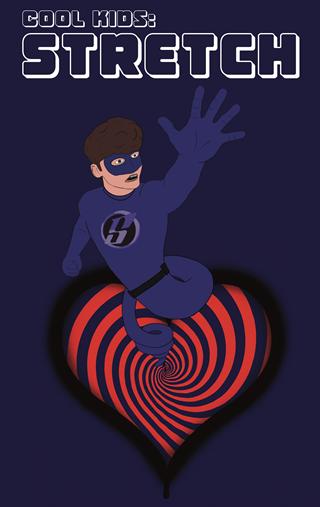 When Faughnan set out to create a comic book for his senior art project, he opted to do the illustration by hand rather than using AI.
The comic book is based on an independent superhero movie made by Faughnan’s brother.
“Everyone liked one character, Stretch, in particular,” Faughnan said. “We planned a mini-series, but that didn’t work out. I needed a senior project, so I made it into a comic book.”
Faughnan worked with his brother, who wrote the story, to create a 32-page comic book that fit the story that had already been told while elaborating on the side character. Ultimately, Faughnan had copies printed and has also published the comic book online at https://curtisfaughnan.github.io/Comic-Shelf/.
“I would look at old pictures of the character, start designing, and then take that to Procreate software to draw out each individual panel,” Faughnan explained.
He pointed out that his artistic approach will be useful in creating a pleasant user interface with the work he is doing with EchoTech.ai.
Gonzales and Furuness both feel they learned a lot from Faughnan. Gonzales said his favorite thing about Faughnan is his energy.
“We kind of balance each other out,” he said. “If I was struggling with projects or getting my mind right to work on something, Curtis would say, ‘I’ll help you, I’ll sit with you, I’ll talk with you. The energy that he brings to everything, while it is in a more reserved manner, I really appreciate that about him.”
“The biggest thing I learned from Curtis was not to discount anyone’s ideas,” Furuness said. “Listen to what everyone has to say, even if you disagree with them. What they’re saying might give you an idea of what to do next. You can still learn from them.”
Weedman credits a certain softness in Faughnan’s affect that allows him to disagree without confrontation.
“It’s a challenge to structure and ask the right questions,” Weedman said. “He’s taking authority and asserting, but he can softly push out a question to make himself heard.”
Furuness continued, “I think Wabash does a good job of putting you in a place where you can fundamentally disagree with somebody and still be able to decide you want a friendship with this person.”
Faughnan agrees that the brotherhood of Wabash is real.
“‘No one wants to see you fail’ is something I didn’t believe at first,” he said. “But all the guys I’m with in senior studio, for art, for capstone, for computer science—I see now that it’s true. No one wants to see you fail. They’re all with you.”