
“John and I drove over to Ancona, caught the ship, and went to Greece,” Associate German Professor Gregory Redding ’88 recalls of a postgraduation journey with John Fischer H’70, his Wabash mentor. “He made you feel like a co-intellectual. We would be on a tour with John, traveling around the Roman Forum, and he’d be resurrecting these walls and bringing them back to life. You’d look around and suddenly realize he’s like the Pied Piper. All of these people were following along and eavesdropping on him.”
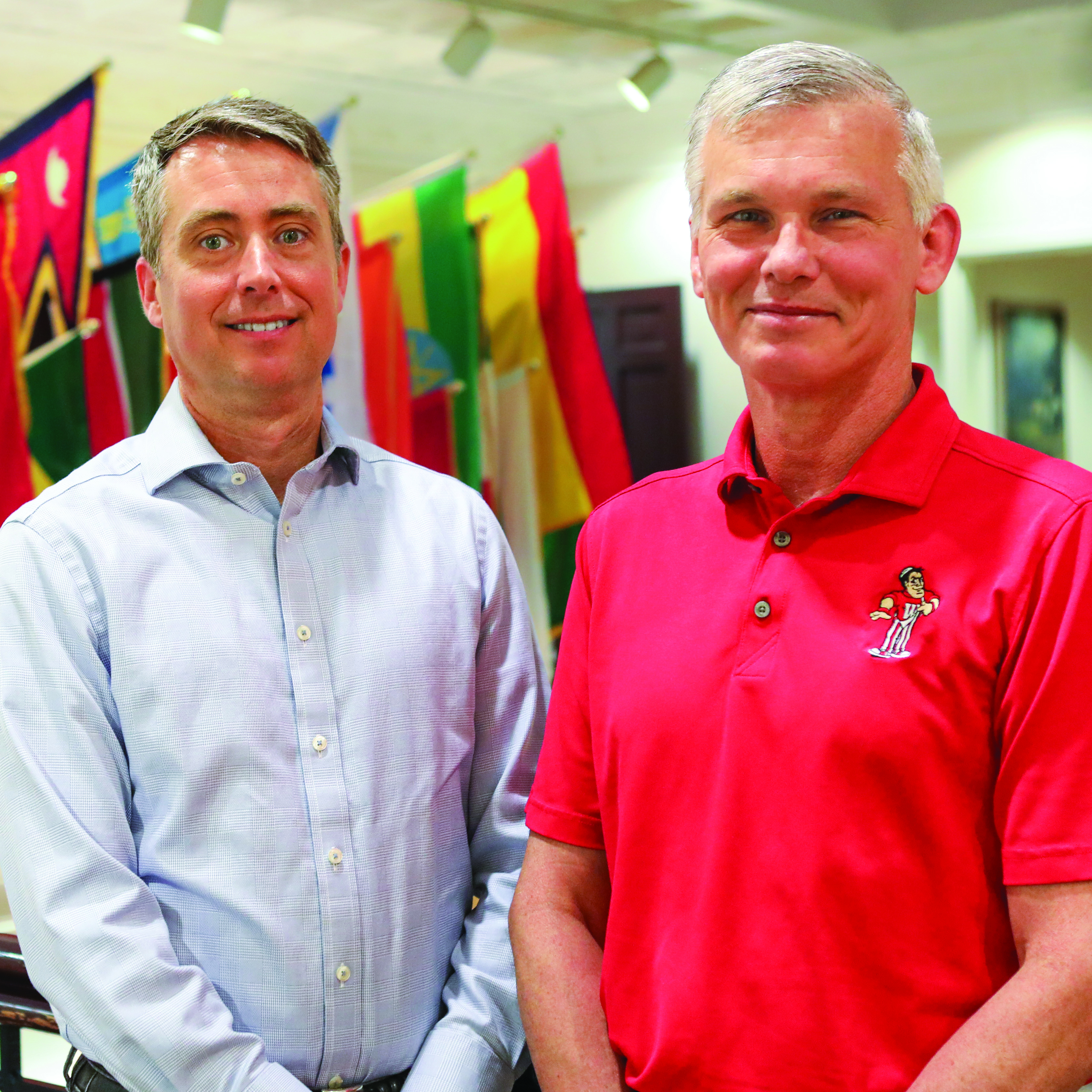 Brian Tucker ’98, now a professor of German, received a similar invitation around a decade later. The day after graduation, he boarded a plane to Athens, Greece, where Fischer picked him up in a yellow Volkswagen bug named Midas. Together they drove across Greece, stopping at Delphi, Olympia, and the port of Piraeus, turning ancient ruins into living classrooms.
“I felt like I was really there to study,” Tucker says. “That distinction between being a tourist and immersing yourself in the culture—that’s something I try to carry forward for our students.”
Today, Redding and Tucker teach in the same classrooms where they once sat as undergraduates. Their work in leading immersion courses and insisting that language learning should widen a student’s worldview has institutionalized the kind of mentorship Fischer once practiced informally, turning formative world exploration into a structured part of the curriculum.
Both Redding and Tucker studied abroad in Freiburg, Germany, as Wabash students, and they both had early mentors who made the world feel accessible and the pursuit of learning exciting.
“Those first semesters here were a shock,” Redding recalls. “You realize quickly there’s another level of work you have to learn how to do. But German with Robert Glenny was the class I always looked forward to.”
Later, Redding’s interest in the language was deepened by Andreas Lixl, a professor from Austria, but when Redding returned from studying abroad in Freiburg, the department had changed. Glenny and Lixl were gone, replaced by John Burns and Hamilton Beck. Beck encouraged him to pursue graduate study.
Tucker credits Fischer most directly for shaping his academic trajectory, pushing students to spend a full year abroad, and persuading them that the world beyond Crawfordsville was not a distraction but an adventure worth taking.
 “He had to convince us that we weren’t missing anything here in Crawfordsville; you’re better off out in the world,” Tucker says. Fischer even helped him secure a summer internship with Professor of Classics Leslie Day in Crete.
Tucker remembers feeling inducted into a “special club” of scholars who traveled not just to sightsee or consume the culture but to study and learn it.
Neither Redding nor Tucker initially expected to return to Wabash as faculty. Their paths led through graduate school and other institutions. But when they did return, they found a department in transition.
“We didn’t have short-term immersion programs or class-based travel with a professor when we were students,” Redding says. “So when we studied abroad, you were just gone, and that had huge value. You were really cut off from here. You had to make your own life there and dive into the language.”
Beginning around 2000, Professor of German John Burns started immersion courses in the German department. Redding joined Burns in 2003; Tucker followed in 2006. Every year since—except during the COVID-19 pandemic—one of them has taken students abroad. The two have even traveled together roughly a dozen times.
Immersion learning has become a defining feature of German at Wabash.
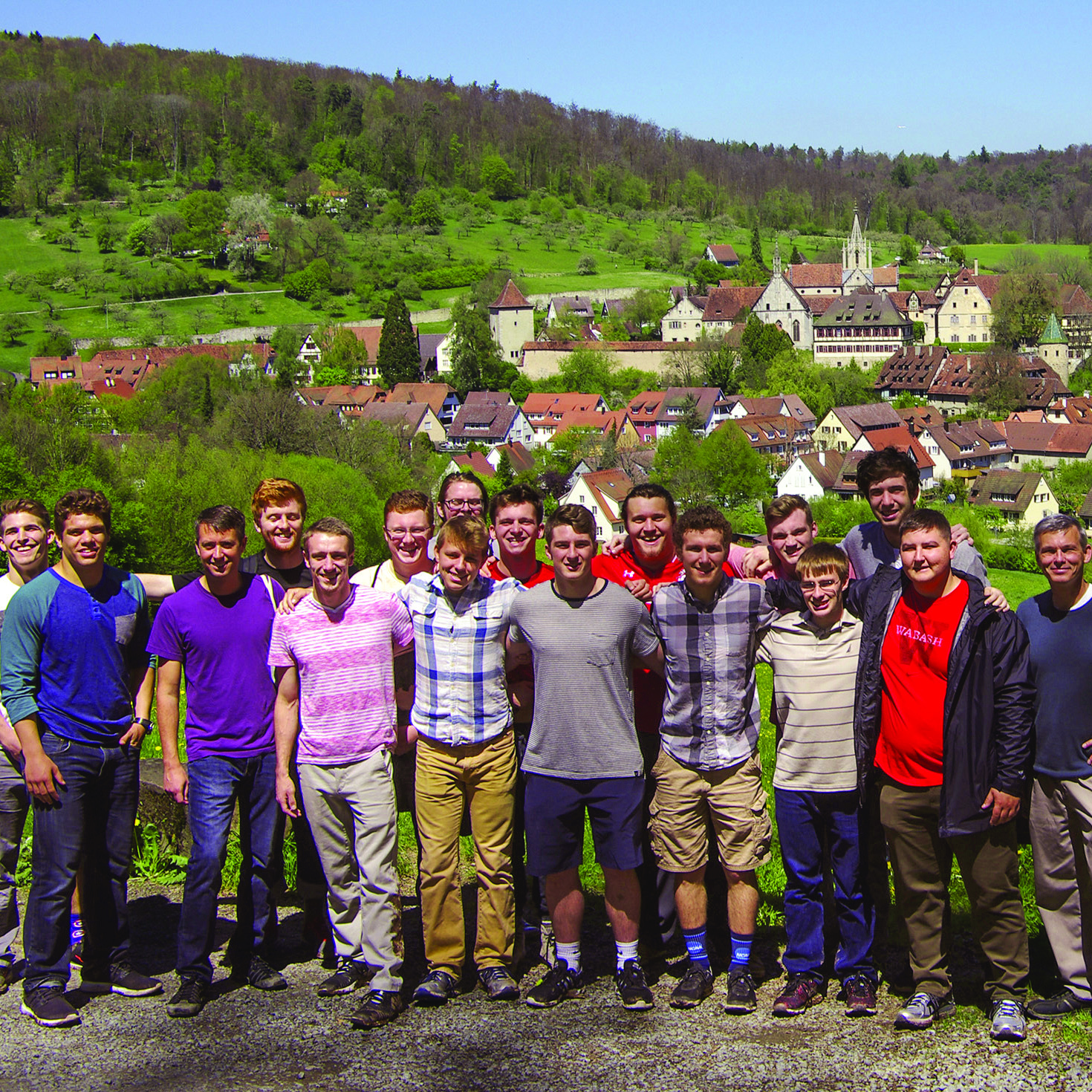
“What I love about what we do now is that we are this traveling group of scholars,” Redding says. “We go with these guys, we come back with these guys, we have courses afterward, and we build on the things we did abroad.”
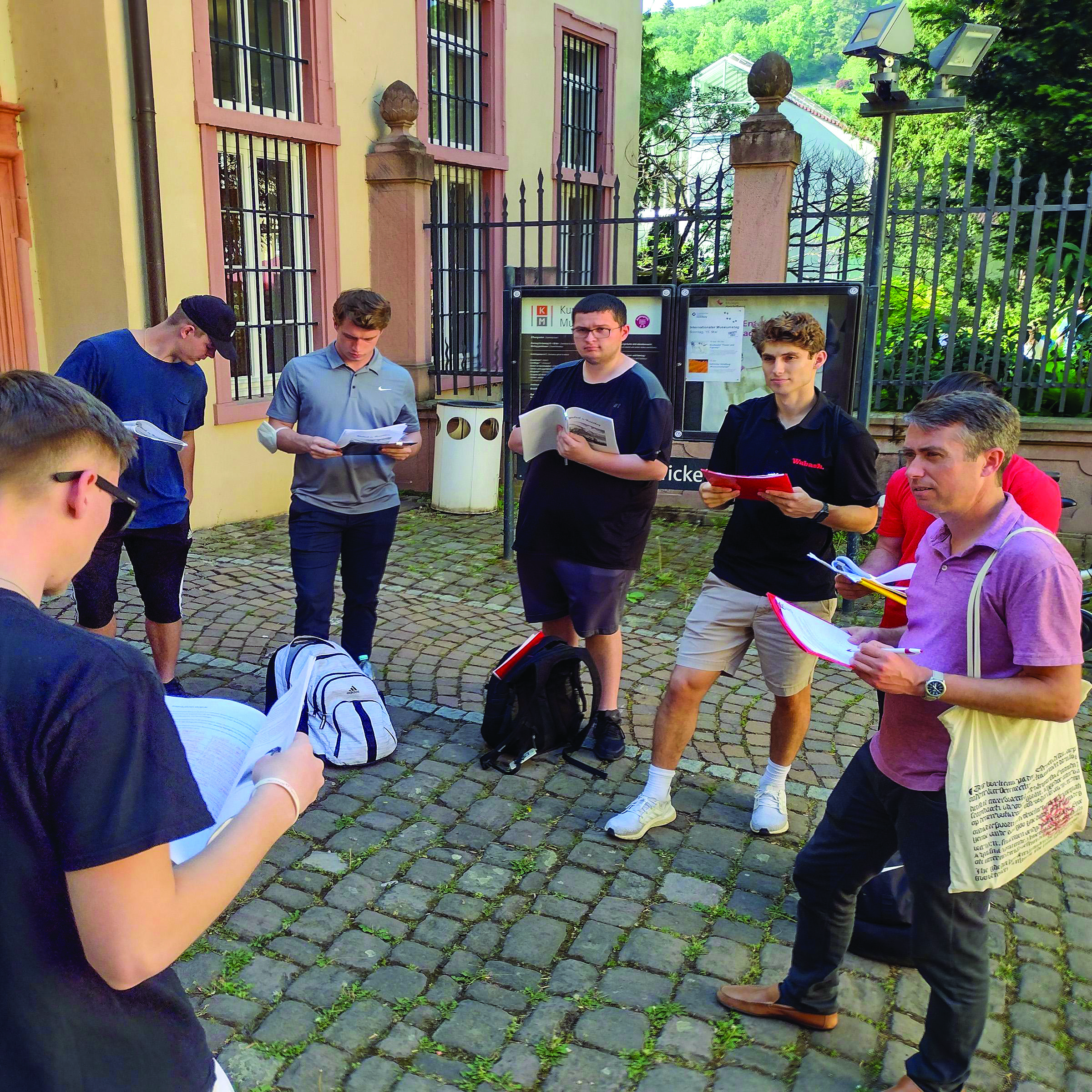
The German immersion course model pairs a semester-long course with about two weeks abroad, often in a university town such as Marburg or Heidelberg, Germany. Mornings are devoted to structured language instruction, afternoons to immersion activities. Redding has calculated that students receive nearly a semester’s worth of German contact hours in two weeks.
The course design reflects a shift from solely historical and literary study to lived language.
Tucker sees immersion learning as a continuation of Fischer’s model of mentorship: faculty guiding students through intellectual landscapes and teaching them to be curious about the world.
He admires Redding’s gift for noticing details—an inscription, a peculiar building, a cultural moment—and drawing students toward curiosity.
 “The students all walk past something, and Greg will say, ‘Oh, this is neat,’” Tucker says. “They’ll gather around, and they’ll learn something. They just needed someone to slow them down and to pay closer attention to the world.”
Immersion learning has helped attract and sustain student interest in language learning amid a nationwide decline in high school German programs.
“When I started here, you could count on every year having a cohort of students who came in with a strong high school background and intended to major in German,” Tucker says. “Now our bread and butter are guys who start in 101 and get excited about it.”
That shift forced curricular changes, including allowing introductory courses to count toward the major. Immersion courses became one of the most powerful recruitment and retention tools.
“We have to create that interest,” Tucker says. “Immersion travel is one of the most impactful ways we can do that.”
For Redding, the continuity between past and present is embodied in the faculty themselves.
“If you’re a teacher, you’re just a composite of every teacher you’ve ever had,” he says. “You emulate what was brilliant, and you decide what not to repeat.”
The Max Kade Foundation has supported the German immersion program for almost a decade by contributing $1,500 per student to cover travel expenses. In addition, alumni, trustees, and donors—many of whom had their own transformative experiences abroad—funded programs that expanded those opportunities beyond a privileged few.
“A lot of places, you take your German course and then you need $5,000 to participate in the trip,” says Tucker. “We’re not transactional like that. If you’re enrolled in the course and you’re a student in good standing, Wabash will pay your way.”
When Fischer drove a young Tucker through Greece or lectured impromptu crowds at the Roman Forum, he was not likely thinking about his institutional legacy. Yet those moments seeded a philosophy that now reaches dozens of Wabash students every year.
They view their work not simply as teaching German but as teaching students how to inhabit the world with curiosity and confidence.
Redding says, “We are lucky to have resources to do it on a larger scale for more students.”