
Augusto Ghidini ’26 arrived at Wabash College from Brazil four years ago with a racket in hand and a fairly straightforward plan: play tennis, study economics, improve his English, and eventually return home with a degree.
Then, during course registration before his freshman year, he selected a French class on impulse.
“I could only count to three in French but for some reason I was like, ‘Yeah, why not?’” Ghidini said.
Soon, he was hooked — enrolling in French every semester afterward, studying abroad in Strasbourg, and eventually completing comprehensive exams in the language.
“French just happened to me because of Wabash,” he said. “And it was awesome.”
This was just the first of the unexpected turns of Ghidini’s path through Wabash, leading to his transformation from the anxious teenager who arrived in Indiana to the confident college graduate now returning to Brazil.
“These years have honestly changed me in every way for the good,” he said. “Mentally, emotionally, academically.”
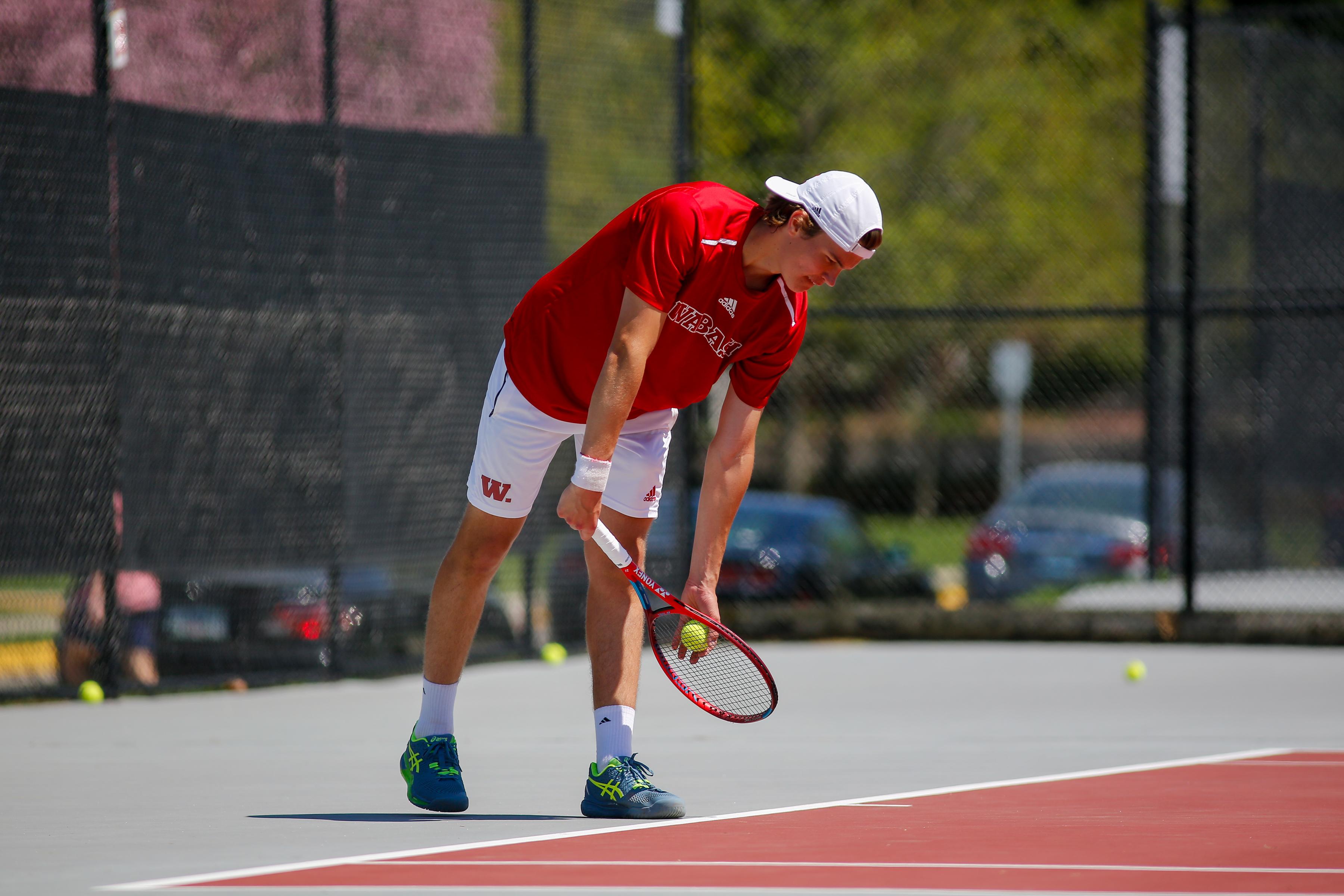
Prior to Wabash, the pathway Ghidini envisioned for himself looked different. Competitive tennis and college athletics were not intertwined in Brazil the way they are in the United States. Players had to choose whether to pursue the sport professionally or attend college separately. He wanted both.
Ghidini moved from his hometown to a tennis training center in São Paulo designed for athletes hoping to study and compete in the United States. Coaches compiled recruiting videos and connected players with American programs. One of the coaches who responded was Wabash tennis coach Daniel Bickett.
Ghidini still remembers their first conversation.
“I immediately loved him,” he said. “He told me about the tradition, the academics, the community at Wabash. And I ended up here in Indiana.”
The move was not without challenges. There was the cold, for one. Ghidini had never felt below zero temperatures. There was homesickness, too, and the uncertainty that comes with entering a new culture thousands of miles from family.
“At the end of the first semester, I remember thinking, ‘There is no way I’m going to be able to do this seven more times,’” he said. “I thought maybe I would have to go back home.”
But Wabash gradually became a second home. Ghidini had worried initially that he would feel isolated as “the Brazilian guy” among mostly American teammates on the tennis team, but he encountered the opposite. His teammates became his brothers through daily practices, long van rides, hotel stays, and matches scattered across the country — Kentucky, Florida, California, Michigan, Ohio, Illinois.
“I couldn’t have asked for better people around me,” he said. “Every single moment was fun, just being with them and competing and traveling together.”
Bickett saw Ghidini pour his energy back into the team.
“There is not one specific moment that captures who Augusto is as a teammate, but rather all the times he would walk into the tennis center and just start singing or dancing,” said Bickett. “It’s the long car rides back from away matches when a random Justin Bieber song would come on, and he would sing it word for word. It’s the connection he made amongst his teammates by always being his true self.”
Ghidini was also surprised to find that he wasn’t “the Brazilian guy” on the team because there were several others.
“Five of the six Brazilian students on campus are members of the tennis team,” he said, laughing. “We kind of took over.”
Ghidini and his doubles partner, Rafael Rin ’27 from Rio de Janeiro, emerged as one of the NCAC’s strongest pairings of the 2025-26 season, posting a 16-7 overall record, including a 5-1 record in tournament play.
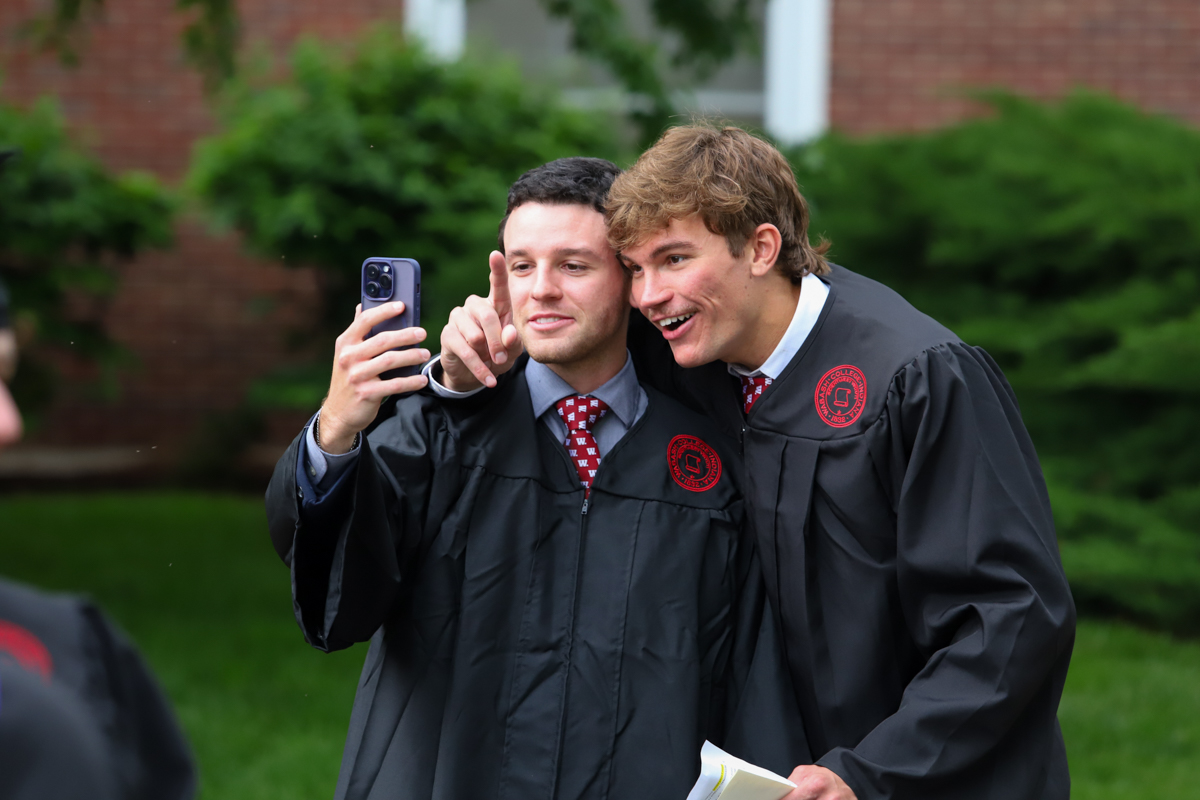
But tennis alone does not account for the economics and French double major’s affection for Wabash.
Ghidini spoke just as enthusiastically about the Lilly Library, where he claimed a regular table and built friendships with staff members and fellow students. He recalled reading Dante in Associate Professor of English Warren Rosenberg’s Divine Comedy course during his freshman year and struggling through the workload before realizing how much stronger it made him as a writer and thinker. He remembered Professor of Psychology Eric Olofson’s course on fatherhood that challenged him to think differently about people and relationships.
“That’s what was so cool about the liberal arts experience,” Ghidini said. “I had so many opportunities to challenge my thoughts and open my mind.”
Nowhere was that openness more apparent than in his study abroad semester in France.
Arriving in Strasbourg marked his first time in Europe, and for several days he was so intimidated by the language barrier that he barely ate.
“I didn’t want anybody to talk to me,” he said.
Eventually, his fear and hunger gave way to confidence. The same student who panicked over ordering food in French would later complete advanced coursework and comprehensive exams in the language. Today, Ghidini speaks Portuguese, English, Spanish, and French, and he hopes to someday add Italian to the list.
For all the experiences he accumulated, he still speaks about his college years with disbelief of how quickly they unfolded.
A few weeks before Commencement, his mother sent him a photograph taken before he left Brazil as an 18-year-old preparing for the journey to Indiana. Around the same time, he had renewed his passport and compared the photos side by side.
“I looked like a kid,” he said. “And that kid did not know what was coming.
“It’s time for another big change, and I feel ready for whatever comes next,” he said. “Because of Wabash, and because of everything I learned and all the incredible people I met.”
Now the Wabash graduate returns to Brazil, at least temporarily, to spend time closer to family. Beyond that, the future remains intentionally open. Graduate school in the United States is a possibility. So is Europe. So is a chapter he has not yet imagined.