
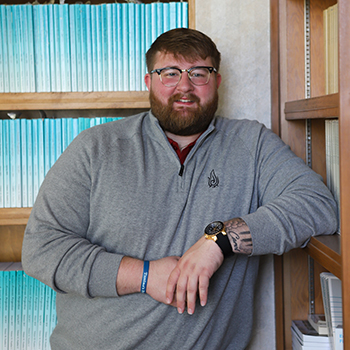
Hayden Lewter ’26 came to Wabash from Hammond, Indiana, with an associate degree in criminal justice already in hand, having participated in an early college program through Vincennes University. The psychology major and Black studies minor was recruited to play football for Wabash; however, during his freshman year, Lewter injured his knee and considered giving up football, but made a return. His sophomore year, he suffered what he decided would be his last football-related concussion.
 “After two different doctor opinions, I thought it was just time to be done,” Lewter said. “Especially with all of the research that’s going into chronic traumatic encephalopathy. That’s when I turned to non-athletic campus involvement.”
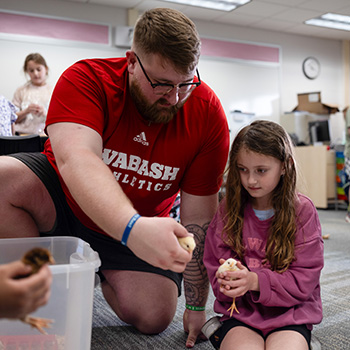
In the course of his college career, Lewter served as risk manager and rush chair at Delta Tau Delta fraternity and joined College Mentors for Kids and Best Buddies. The last two years he has been focused largely on the Malcolm X Institute of Black Studies and peer health education.
Lewter’s initial interest in criminal justice came from a deeply held admiration of his father, a former police officer, but as he learned more about peer health education, Lewter pivoted into psychology—honoring his father’s influence through a different path.
“I always had an underlying interest in wellness and mental health,” Lewter explained. “I had a cousin who died by suicide.”
Seeing the decline of mental health in high school and college students, Lewter saw peer health education as a potential way to make an impact. Lewter hopes he has helped strengthen the foundation for men’s mental health at Wabash.
“My name doesn’t have to be attached to anything,” he said, “but if peer health education is still happening, I can come back in 15 or 20 years and know I participated and helped develop that.”
Kim King, the assistant director of the Malcolm X Institute of Black Studies, has seen first-hand the impact Lewter has had on campus and within the MXIBS.
“It’s hard to imagine anyone with a larger footprint on campus than Hayden Lewter,” King said, “between the work he’s done in psychology around mental health and the leadership and the connective tissue that he provides here at the Institute.”
King said that during Lewter’s time as secretary of the Rams Horns—the officers of the MXIBS—Lewter has striven to do his job in such a way that it elevates all other officers.
“It’s clear that Hayden’s organizational hand, the way he has communicated with campus writ large has facilitated an expectation for how things are done,” King said. “He took it from a secretarial role within the MXIBS to a leadership role on campus, helping the Institute interface with the campus more effectively and boldly.”
Despite that boldness, Lewter is also a comforting presence around the MXIBS.
 “He’s like Linus’ blanket.” King said, smiling. “He has the rare capacity to connect with students and parents. I can think of times when he would walk up to a conversation, and I could trust him enough that I would recede into the background and let Hayden do what Hayden does.”
King also emphasized that Lewter leverages his personal relationships and his position as a campus leader to amplify voices that often aren’t heard enough on campus.
“In his Chapel Talk, he not only challenged us to live into what brotherhood really means, but then boldly admitted that the Institute, this space that is steeped in the history and legacy of students of African descent, is where he has experienced it most authentically.”
Professor of Psychology Preston Bost, who worked with Lewter on his senior capstone project, called him a “pay-it-forward kind of guy.”
“It’s a classic Wabash story of a young man discovering his core while he’s here,” Bost said. “I can see him growing into this community-minded, professionally-minded, fully-adulted, whole human. He feels so secure in what he values. I'm really, really proud of him.”
Lewter’s capstone project investigated the feasibility of creating a peer mental health support network on campus—a program that wouldn’t replace but would supplement the offerings of the Student Counseling Center.
“I think peer support programming can help reduce stigma and alleviate pressures, not only just from the broader sense of Wabash, but amongst that cross cultural perspective,” Lewter said. “Our counseling center is great, but sometimes it can be hard to get in there. Sometimes there are cultural stigmas surrounding counseling. So how can we develop this programming? Because research has shown that sometimes just talking to a friend alleviates everything.”
Lewter envisions biweekly gatherings around campus, with locations chosen for accessibility and activities to complement casual conversations about mental health.
“Chai and chill at the MXI,” he suggested. “Board games and mental health at the Latino Community Center. It’s just a place to hang out and relax, no phones, no computers, no iPads. Just walk into the space, leave your stuff at the door, get some snacks, and develop these new relationships for the future.”
Bost was impressed by the scope of Lewter’s capstone project.
“It will diversify the resources available to students,” he said. “It will provide something non-threatening and non-hierarchical. It leverages the Wabash culture and it can expand access to students. He was not just thinking about individuals but also institutionally.”
Lewter has seen firsthand how different environments lend themselves to personal development in different ways.
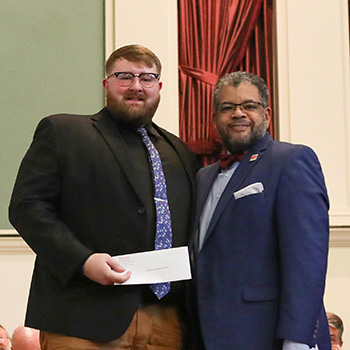
During the summer of 2024, he took an internship with the Light Foundation, an organization founded by former NFL player Matt Light. It was a full-circle moment for Lewter, who had been selected with four other Hammond-based students to participate in the program throughout high school. Lewter was the first recipient of a scholarship award from the Light Foundation.
Lewter related, “I said I would come back as a counselor to help out and be a liaison between high school to getting ready for college and just help in any way I could, as I had always learned our alumni are supposed to do.”
The internship developed into a part-time job that has continued through his time at Wabash. As Camp Vohokase coordinator, Lewter shepherds 16 young men through the course of their high school career, teaching them life skills and how to be better men.
 “The summer before their freshman year in high school, they attend camp for the first time, they sign a contract pledging to be REAL—responsible, ethical, accountable leaders,” Lewter explained. “Throughout the next four years, we hold up our end of the bargain. They have weekly check-ins with me. They participate in seasonal visits, fall, spring, and winter, when I visit them at their hometown. We do professional development, community service, and fun team building activities.”
Bost is impressed with the amount of time that Lewter gives to The Light Foundation.
“He’ll pick up and go,” Bost said. “He’ll take the red eye. He’ll spend time jetting from one state to another when they need to pull resources around one of their young men who’s struggling.”
After graduation, Lewter plans to continue his work with The Light Foundation. But that’s not his end goal.
“I applied for an online master’s program in mental health counseling with Butler University,” he said. “So within the next two to three years, I should get my master’s degree as well as my license for mental health counseling.”
Bost fully believes Lewter will succeed at his future plans.
“He wants to go into mental health work and get into the counseling world,” Bost said. “He’s really going to be good at that.”
King also anticipates Lewter’s impact being a big one.
“Hayden is keenly aware that legacy matters,” King said. “He’s exactly the kind of leader that we want at the table making tough decisions. While the personal keeps the flame stoked, he knows that work has to be contextualized in structures that lead to legacy.”
Listen to Lewter’s Chapel Talk from February 5, 2026, here: https://youtu.be/1CqGKBES64M?si=_oie0VPlZoRiernx&t=450