
For Xavier Tyler ’26, the job was simple: Move the ball forward.
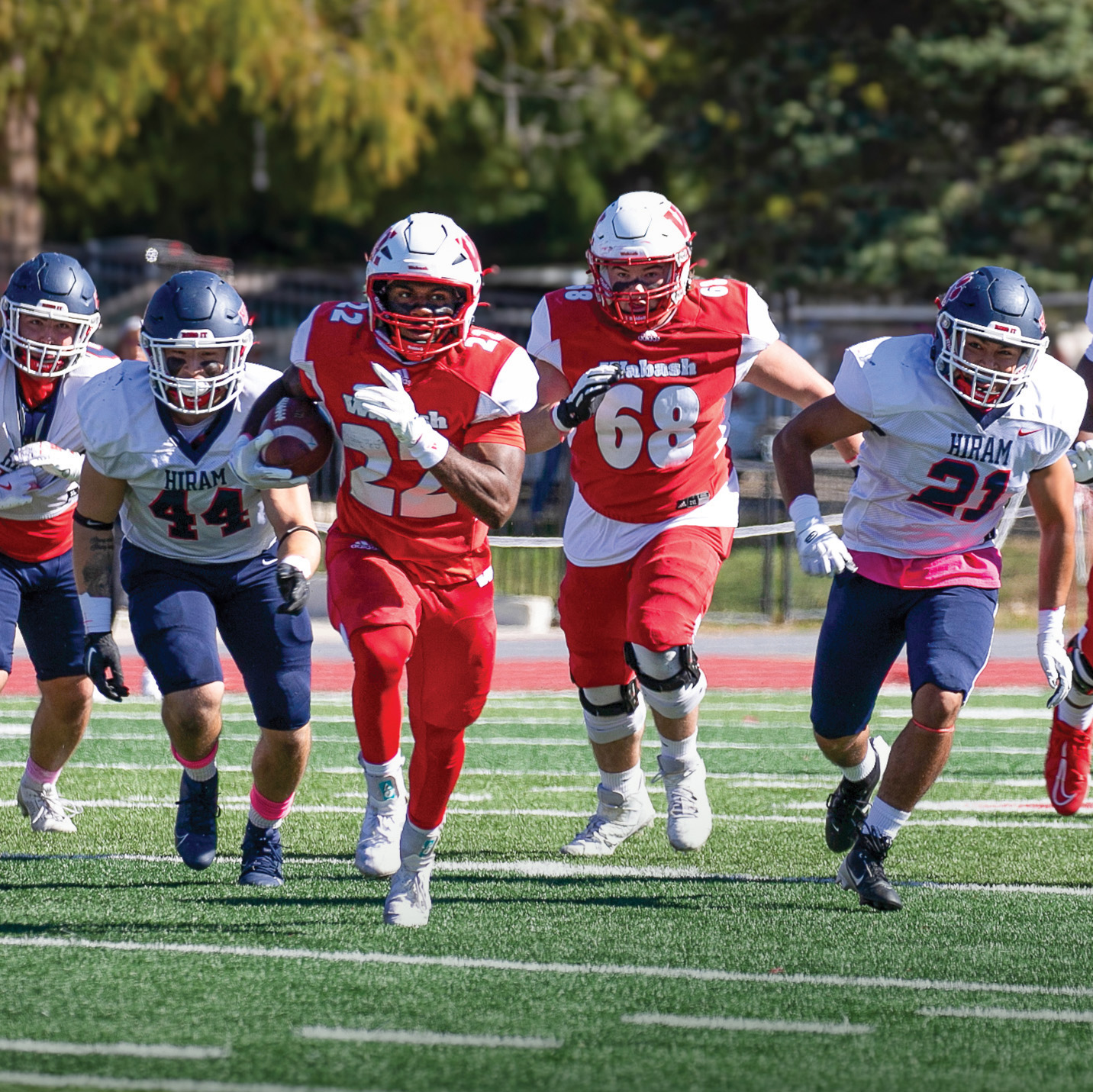
By the time he finished his Wabash football career in the fall, the numbers told only part of the story. He rushed for more than 2,000 yards, recorded eight 100-yard games, and delivered season highlights, like an explosive 70-yard touchdown run against Wooster that put his speed and athleticism on full display.
But the arc of his career was built less on spectacle than consistency and accumulation—carry by carry, drive by drive, season by season.
Football had been a constant in Tyler’s life long before he arrived in Crawfordsville. When he stepped onto Wabash’s campus, life already had a familiar cadence. Weight rooms and game film, practice and recovery structured his time and, in many ways, his identity.
“It’s a unique feeling to finally be without football,” says Tyler. “It’s been a part of my life for so long that it really came to define who I am as a person.”
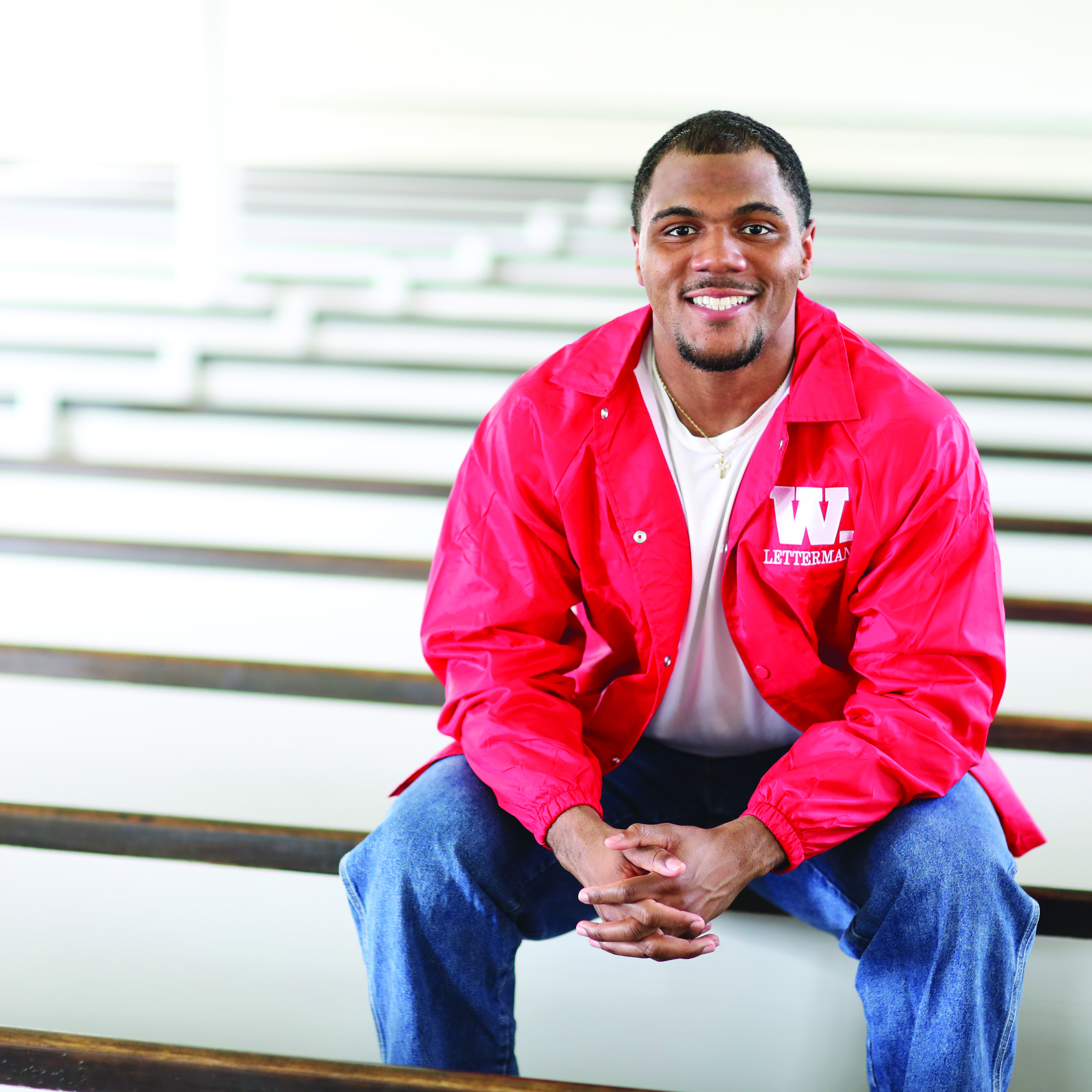 For years, the answer to a simple question—What do you do?—came easily. He was a football player. At Wabash his answer grew more layered: a leader in the locker room, a philosophy major in the classroom, and a steady presence in the Crawfordsville community through the Malcolm X Institute of Black Studies (MXIBS).
A native of Evansville, Indiana, and a graduate of Reitz Memorial High School, Tyler knew he wanted to play football in college and initially looked elsewhere. After visiting Wabash, he saw it as the best fit academically, and the chance to continue his football career mattered. The arrival of Head Football Coach Jake Gilbert ’98 later confirmed that he had chosen well.
“You love to see that somebody is as committed to the sport as you are,” Tyler says. “With Coach Gilbert, we saw someone who was as committed to football as the players were, and that was really refreshing.”
On the field, Tyler’s performance spoke for itself, but within the program his value was evident in quieter ways, and not just on game day. Gilbert relied on him as a stabilizing presence.
“Xavier had an incredible career at Wabash,” Gilbert says. “He led the conference in rushing one year and was second in another. Above all of that, he was an incredible leader and teammate. He served a very valuable role on the leadership council, and his unselfishness was key to our culture. I could always count on Xavier to offer discernment and guidance for our program.”
Tyler’s sense of responsibility—to teammates, to the program, and to something larger than himself—became a defining thread of his time on campus.
“So many people took me under their wing when I was a young guy here,” he says. “They did so much for my life and for me as a person and a player that I had to give that back. It was hard not to find someone else to do that for.”
By his senior year, Tyler was serving as the MXIBS’ community service chair, coordinating outreach efforts and fostering partnerships off campus.
“My class and I set out to rebuild our reputation on campus and in the community,” says one of the most recent winners of the Community Service Award for Outstanding Work. “Allowing the MXI to build stronger relationships in Crawfordsville has been a big part of my experience.”
Kim King ’99, assistant director of the MXIBS, says Tyler’s leadership style mirrors his demeanor—quiet, methodical, and effective.
“Many leaders confuse the title of importance with the actual work of doing important things,” says King. “With an incredibly unassuming nature, Xavier Tyler only preoccupies himself with the latter. His leadership, especially around community service, has galvanized the MXI’s position in the broader community.
“I am especially proud of the way he has helped his brothers get involved with Culture Night at Crawfordsville High School,” King continues. “And he has done these things while making sure that the Institute’s efforts are accountable to Wabash’s office of community partnerships.”
Tyler also helped organize the Institute’s annual Thanksgiving food drive for Grace and Mercy Community Food Pantry—garnering increased campus participation every year.
“It was nice to see the campus come together and really buy into that food drive,” Tyler says. “We try to do things where we can get 10-plus guys out in the community at one time. It’s about showing up consistently.”
Consistency—showing up day after day—is a lesson Tyler traces back to his mother.
“My mom is the definition of hard work,” he says. “She showed me what hard work can lead to.”
His mother’s example guided him as he balanced athletics and service and even shaped his academic path. Initially a chemistry major, Tyler eventually found his academic home in philosophy.
“Philosophy challenged my mind in a different way than chemistry did,” he explains.
 His senior seminar paper reflected the same analytical rigor and concern for equity that mark his campus leadership. He examined the historical materialist approach to race in the United States, proposing reparations as a framework for addressing systemic racial injustice.
After graduation, Tyler prepares for his next chapter as an Orr Fellow, in which he will begin a career in human resources with American Water. For the first time in years, his schedule no longer revolves around practices, film sessions, and game days.
“I’m excited to finally develop new habits and new hobbies outside of football,” he says.
Still, he knows that the discipline and leadership skills he formed at Wabash will follow him.
“I’m sure I’ll feel some delayed gratitude, knowing that my class played a pivotal role in the positive change we’re seeing in MXI and the football program,” Tyler says. “I just want to be remembered as a hard worker—someone who was always willing to do whatever it took to get the result he was aiming for.”