
Sometimes plans change.
William Boswell ’26 didn’t plan to graduate early. The biochemistry major was mapping out his senior year courses when a sudden realization changed everything: he had enough credits to finish Wabash a semester ahead of schedule.
What happened next spoke greatly to his character.
Rather than coast through a relaxed spring semester, Boswell made a deliberate choice in accepting a research position in the lab of Dr. Stacy Halum, an otolaryngologist at the Indiana University School of Medicine.
Days after finishing his senior comprehensive exams, he traded full days of classes for full days in the lab.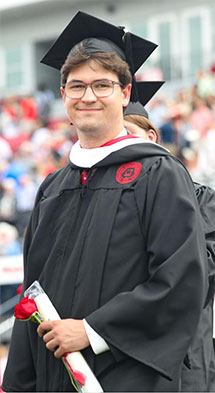
“I felt that the value I would gain working full time in the lab would benefit me more than staying here for that last semester,” said Boswell, who minored in Classics. “Medical school is a process so busy and so competitive nowadays, especially if you want to match into a specialty. Research can be a competitive commodity, and I thought that six months of unfettered research time would benefit me down the line.”
Time has proven him right. Since joining the lab in mid-January, Boswell and his colleagues have submitted two papers to peer-reviewed journals, a level of productivity he doesn’t take lightly.
“I’m a research assistant, but I feel that I’m able to make meaningful contributions,” he said. “Being able to step back and say, ‘This information is helping characterize a treatment that already exists, and that may be beneficial for somebody,’ that will be much later down the road for the work I’m doing, but I find satisfaction in that,” he said.
Boswell is quick to credit Wabash for preparing him to hit the ground running. He earned a Wabash Leaders Scholarship and discovered co-curricular opportunities early through the Global Health Initiative (GHI).
Later, working in Dr. Walter Novak’s research lab on campus gave him both the technical foundation and the professional instincts to contribute meaningfully in Halum’s lab from day one.
“Wabash prepared me really well to read scientific literature,” he said. “Being able to read the literature and then move into a research space and make decisions based off of that reading in an actual research context, that’s been very interesting.”
He remembers developing a few more skills back on campus.
“In addition to the productivity, the independence, and the research skills, I’ve been able to connect extensively with medical students, residents, and attending physicians,” he said. “Those were skills that I learned at Wabash. The beautiful thing about a liberal arts education is you study broadly.”
Boswell is honest about the opportunity cost of his decision, of missing a final semester alongside his fraternity brothers, a handful of classes with favorite professors, and enjoying one last bit of the Wabash experience.
“I miss being there,’” he admitted. “The decision I made was smart for my personal path. I don’t know that it would be for everybody, but I stand by it. I feel like I’m doing good work and representing Wabash well.”
With medical school beginning in July, Boswell has a clear sense of what matters most to him. He spoke of three priorities: his faith, relationships he holds with family and friends, and the work itself—specifically, the chance to treat patients.
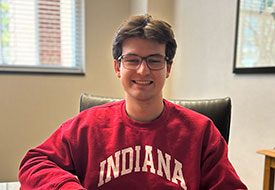 “Will was ready to get started with both classwork and co-curricular activities even as a freshman,” said Jill Rogers, health advisor and GHI program coordinator. “He was exceptionally focused and mature, one of the most serious-minded students I’ve worked with. It is absolutely par for the course that he chose to graduate early. His work ethic is only topped by a deep curiosity to learn.”
This research stint is a continuation of the work he put in as an undergraduate, serving an internship every summer, including the GHI, the University of Texas McGovern Medical school, and a ranch in Wyoming, where he served as an EMT.
“The academics are great. Publishing papers, doing research, being a doctor, all those things will be fun,” he said. “But I think the work in undergrad that was the most gratifying was the times I was able to treat patients and make a difference in their lives. Doing good work in terms of treating patients, being able to hopefully improve somebody’s situation—that’s gratifying to me.”
Boswell still finds value in this space where he is in between chapters. The path is unmistakable: a Wabash education, medical school, patient waiting down the road. For Boswell, there is joy in the preparation.
“Of all the experiences I’ve had, I thought they could be helpful,” he said. “I just committed to it and did the best that I could. The ability you have to access and care for someone is what changes over time. Investing in those skills early and often and taking ownership of them is important.”