
While he was floating in St. Lucie, surrounded by Florida’s beautifully diverse ecosystem, it hit him.
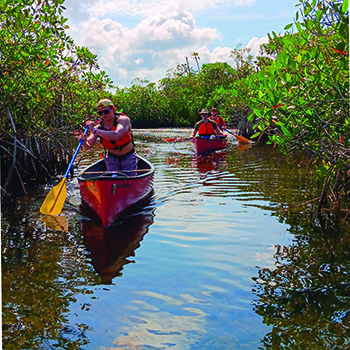 “I want to be doing something in the water for the rest of my life.”
Matt Lepper ’25 had an epiphany on a boat his junior year. It was during a spring break immersion experience with Biology Professor Brad Carlson’s advanced ecology class in the Florida Everglades.
During that experience, the biology major and environmental studies minor assisted in gopher tortoise research, collected data for an independent research project, gave a presentation in a cypress swamp, and, ultimately, discovered his niche.
“My passions lie in aquatic ecology,” says Lepper. “That’s what I’m going to do.”
Carlson recalls Lepper soaking in every moment of the immersion trip.
“He’s clearly at home in the wilderness. He is eager to see, touch, and talk about living things, and quick to make connections with people everywhere,” he says. “I remember the joy and curiosity on his face as he helped remove a gopher tortoise from its burrow for examination, and him giving a bear hug to a guide who led the group on a boat tour along the Florida coast.
“There was no doubt from watching him on that trip that a career in fish ecology would be perfect for him.”
Lepper has been accepted into graduate school at the University of Wisconsin-Green Bay (UWGB), where he will study environmental science and policy.
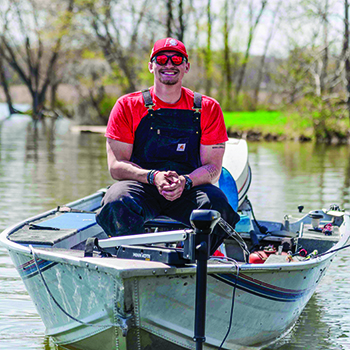 Starting this summer, he will join UWGB’s aquatic ecology and fisheries labs and will begin conducting research on fish species as part of a four-year project funded by the Wisconsin Department of Natural Resources (DNR) to assess the success of prior conservation efforts.
“I’ll be examining things like the reproduction of a few fish species, their population dynamics, and what their movement is like,” says Lepper. “We’ll be looking at big fish species, mainly yellow perch, all the way up to large apex predators like lake sturgeon and northern pike.”
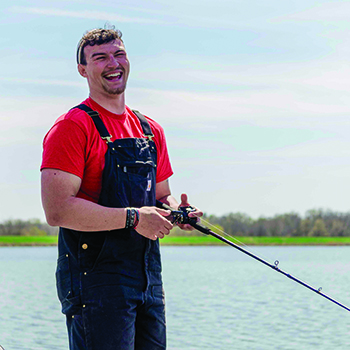
Dubbing himself “the outdoorsy kid,” Lepper recalls his summers growing up being spent wading through a creek or hopping on a boat to cast out a line.
“I’ve been a fisherman for as long as I could hold a rod,” says the Fort Wayne, Indiana, native. “That’s been my life blood outside of academics and athletics.”
Lepper took all the earth science classes offered in middle school, thrived in advanced biology and chemistry in high school, and wanted to attend a college where he could explore careers in the field.
At Wabash he joined the Sphinx Club, became a Global Health Initiative fellow, worked as a biology department research assistant, served as president of the Independent Men’s Association, and chaired the Environmental Concerns Committee.
“Once I saw how much you’re able to do here and how much this place will support you in being involved, that was when I knew this is the place for me,” says Lepper, who took advantage of opportunities to attend cultural and sporting events as well as hear speakers and lectures on campus.
Lepper is particularly proud of his work with the Environmental Concerns Committee, from leading community cleanup efforts and serving veggie burgers at Sphinx Club social events to partnering with Carlson on a recycling project that led to Wabash being awarded a $34,920 grant from the Indiana Department of Environmental Management for new campus recycling bins.
“My mom and grandpa came for a visit last semester, and as I was taking them on a tour of campus, I gleefully pointed out all the recycling bins,” Lepper says with a laugh. “It was exciting to see the work we put in that stemmed from a passion for trying to preserve, to protect, and to revitalize turned into a tangible thing having a positive impact.”
Biology Professor Amanda Ingram says she is inspired by Lepper’s efforts to educate and get his classmates excited about ways they can create a greener environment.
“I’ve really appreciated how Matt never seems frustrated and works to find projects he feels the community can get behind,” says Ingram. “The energy he brings to projects just fires up everyone around him.”
 Lepper’s drive impressed the Smithsonian Environmental Research Center (SERC) in Edgewater, Maryland, which hosted him as a Terrestrial Ecology Lab intern for two summers.
Lepper investigated how microbes and environmental stressors can affect soybean growth. He also got to be a part of BiodiversiTree, the largest tree study in the country, which investigates more than 14,000 trees and studies how tree biodiversity affects ecosystem function.
“The first summer was a ton of bolstering my lab and field techniques, and the second time around I was like, ‘I can really do this thing,’” says Lepper. “It gave me the confidence and reassurance that I’ve been around the block before. I’m getting good experience, and I’m prepped to take on whatever’s next.”
The internships also gave Lepper an opportunity to show off his leadership skills.
“In both summers there were tons of instances where I had to think critically, then trust my gut and preparation to move forward,” he explains. “There’s a form of leadership that happens even when there are not others to lead, like leading yourself through a situation. At Wabash, that’s been ingrained into my mentality. I approach things as a leader whether there’s a group of people or I’m leading myself.”
SERC is home to some of the most productive and respected researchers in the field, Carlson explains, and it’s clear to him Lepper was able to hold his own and represent Wabash well.
“Matt must have made an impression on them, because even though we provide support to send one student per year to SERC, it’s the first time since I’ve been here that we were asked if we could find a way to send a student back,” says Carlson. “The opportunity to be embedded in an entire community of scientists and to be given an important role was central to maturing him and enculturating him into the world of ecological research.”
“You learn a lot in your first summer research experience, but you learn a lot more when you can go back and bring the skills you’ve already learned and the understanding of how science is a team sport,” adds Ingram. “SERC is an amazing environment for someone who wants to immerse themselves in ecological research. I am so glad Matt got to be a part of that.”
After he earns his master’s degree, Lepper has dreams of becoming a biologist with the DNR, focused on fish and wildlife, or of continuing to pursue aquatic ecology research.
Carlson says he will miss having his lab assistant and advisee around Hays Hall to share boisterous laughs in class and heart-to-hearts in his office.
“I’ll miss the enthusiasm and the can-do spirit,” says Carlson. “Matt was always ready to do the heavy lifting, to make things happen, and to deliver on promises.”
As he reflects on his last four years, Lepper says he’s thankful for all the opportunities and people at Wabash who helped him figure out where he belonged in the world of science.
“I really found myself at Wabash,” says Lepper. “Coming here is the best decision I’ve made. I wouldn’t trade these experiences with peers, faculty, and staff for anything else in the world.” .