
When Brady Largent ’26 decided he wanted to be a teacher, he was already the go-to math tutor on his bus route. One afternoon, as he helped a classmate with homework, someone spoke up from a nearby seat.
“Brady, you’re really good at explaining things. You should be a teacher.”
“I thought, ‘That’s not a bad idea,’” Largent recalled.
By his junior year at South Montgomery High School, Largent was shadowing a middle school classroom through a career and technical education program. Now a Wabash senior majoring in mathematics and minoring in education studies and music, he plans to teach high school math after graduation. His role as a supplemental calculus instructor is just one of many commitments on campus, which also include serving as vice president and treasurer of sh’OUT, secretary of the Glee Club, and second trumpet in the occasional chamber orchestra.
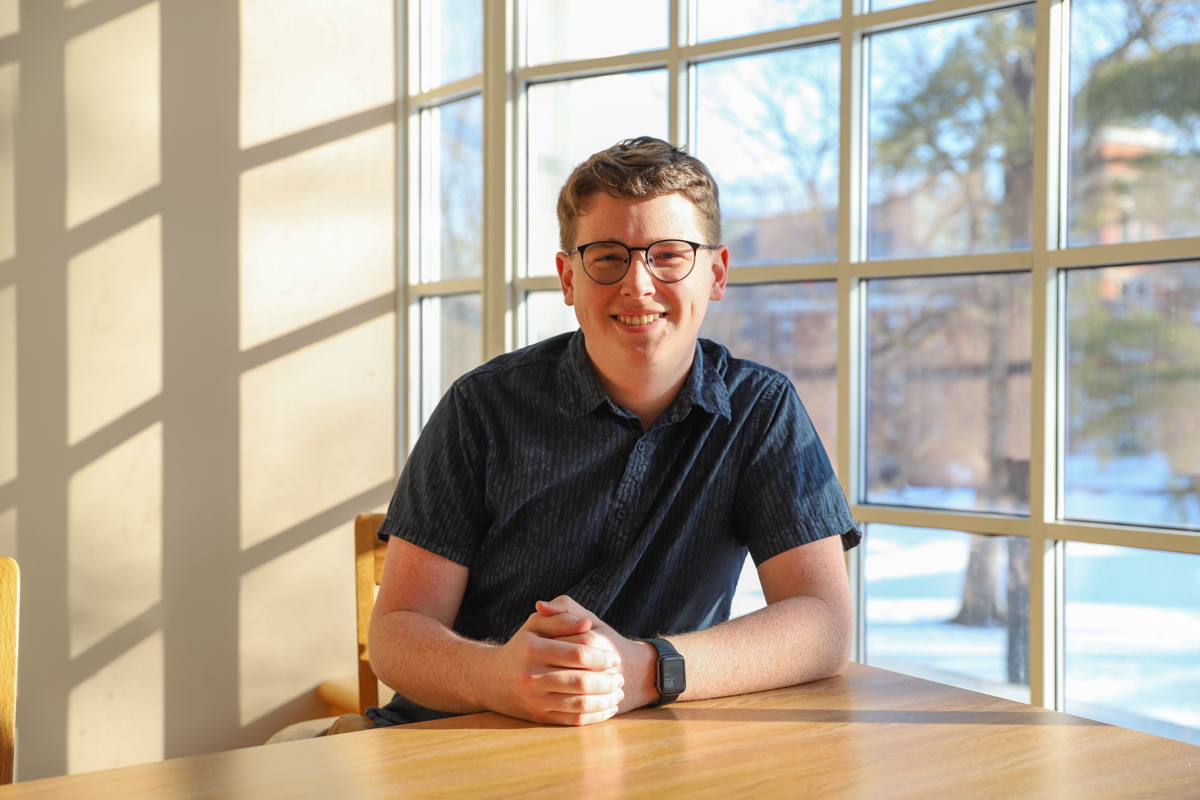
Associate Professor of Educational Studies Michele Pittard noticed Largent’s clarity of purpose the first time she met him during his campus visit.
“I remember his laser focus, knowing he wanted to go into education,” Pittard said. “He was so thoughtful. I remember meeting with him and his mom, but he was the one driving the conversation and asking questions, which is always a good sign.”
Their conversation helped seal Largent’s decision to attend Wabash.
“I wanted a liberal arts education, and I wanted to learn about educational policies in practice, to understand why I am teaching before I just do it,” he said.
That has shaped how Largent approaches the classroom, both as a student and an instructor. He views teaching as a form of social impact, particularly in a subject many students find intimidating.
“In my mind, teaching is the best way to make social change,” he said. “Everyone has that one class or teacher who makes school a bit more bearable. I want to teach higher-level math, like Algebra II and AP Calculus. Algebra II is often a gatekeeper to graduation, so I hope to help students see and understand math the way I do and make school more approachable.”
As a supplemental calculus instructor at Wabash, Largent draws on lessons he first learned while shadowing a middle school classroom.
“The guys I’m teaching now aren’t seventh-graders, but I still have to make it very energizing,” Largent said. “If I go into a classroom giving 80 percent of my energy, nobody’s going to care.”
Pittard sees that enthusiasm play out in her classes, as well.
“Even during those times in the semester when everybody’s tired and overwhelmed, Brady always comes ready to be engaged and brings a positive energy I appreciate,” Pittard said. “He has an honest, open sense of curiosity. He’s a good student, period, so anybody would want to have him in class, but it’s that energy and commitment on a daily basis that really sets him apart.”
That commitment to active learning reaches beyond campus. With the encouragement from the math department and support from the Wabash Women’s Collective, Largent traveled to Budapest, Hungary, last summer to study math and observe how it is taught in Hungarian schools. He spent one of his six weeks in the country teaching at a summer camp in the mountains.
“In Hungary, they use ‘guided discovery,’ where instead of lecturing on a topic and then testing for comprehension, teachers guide students through a series of questions to uncover the concept together,” Largent said.
Largent said the experience helped refine his own teaching style, alongside his education studies coursework and the influence of professors he has admired over the years.
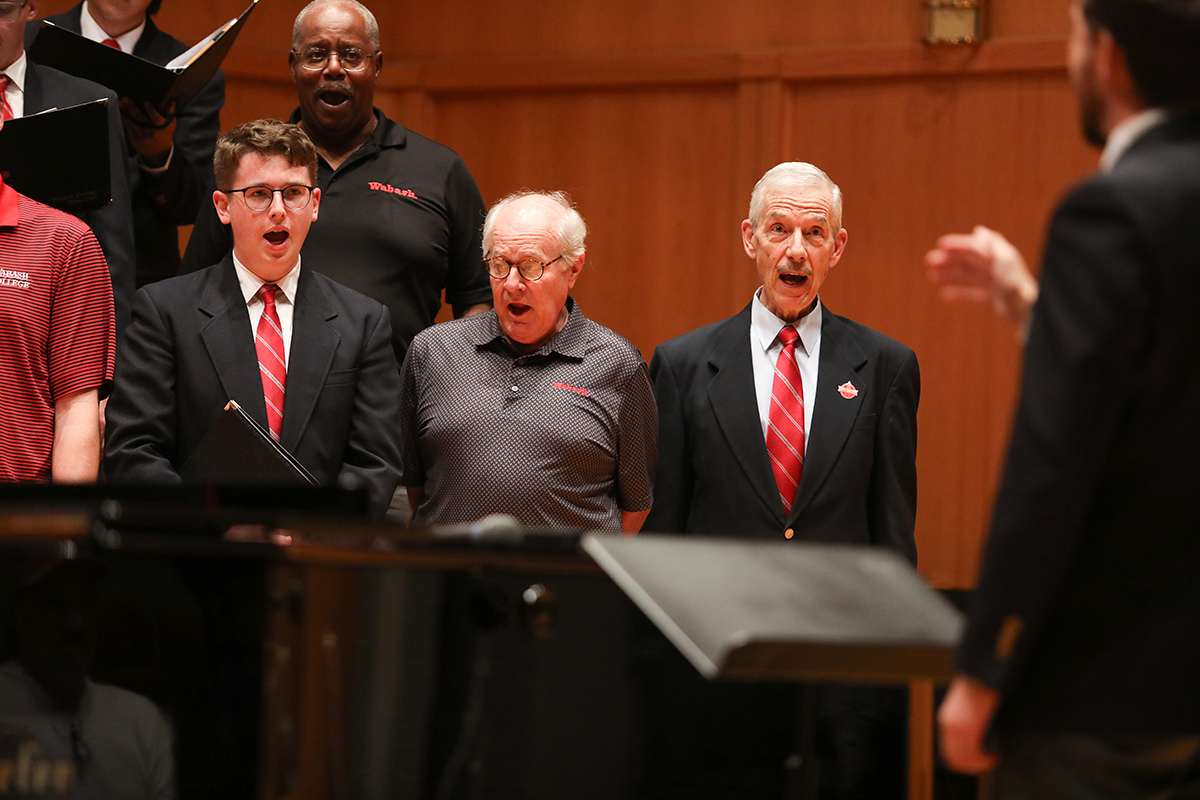
“I feel like every teacher whose class I’ve enjoyed, I’ve taken a piece of what they do,” Largent said.
He pointed to the energy choral director Juan Hernandez brings to both the classroom and the Wabash Glee Club. He appreciated Pittard’s grading system, which contrasts to the mastery-based grading of his math courses because she meets with students evaluate their understanding and performance and decide their letter grade together.
As Largent prepares to graduate, he reflects on how his time at Wabash has shaped him personally.
“I’ve changed fundamentally," he said. “I was in the closet and dating a girl when I came to college.”
He continued on a more serious note: “But really, Wabash gave me the ability to look inward before I look outward. I’m much more reflective now, and I think the biggest change is in how I treat other people.”
His habit of reflection has been influenced in part by the way he learned to think as a math student. While Largent did not love abstract algebra’s endless proofs, Associate Professor of Mathematics Katie Ansaldi’s frequent question to the class — “And how do we know this?”— left a lasting impression.
"Dr. Ansaldi’s class taught me how to look back and see that if we proved one thing here, then it still applies later. That logic is important beyond math. Learning how to think in a more critical way has helped me look at different arguments, even political or emotional, and identify the assumptions I’m making and the assumptions the other person is making.”
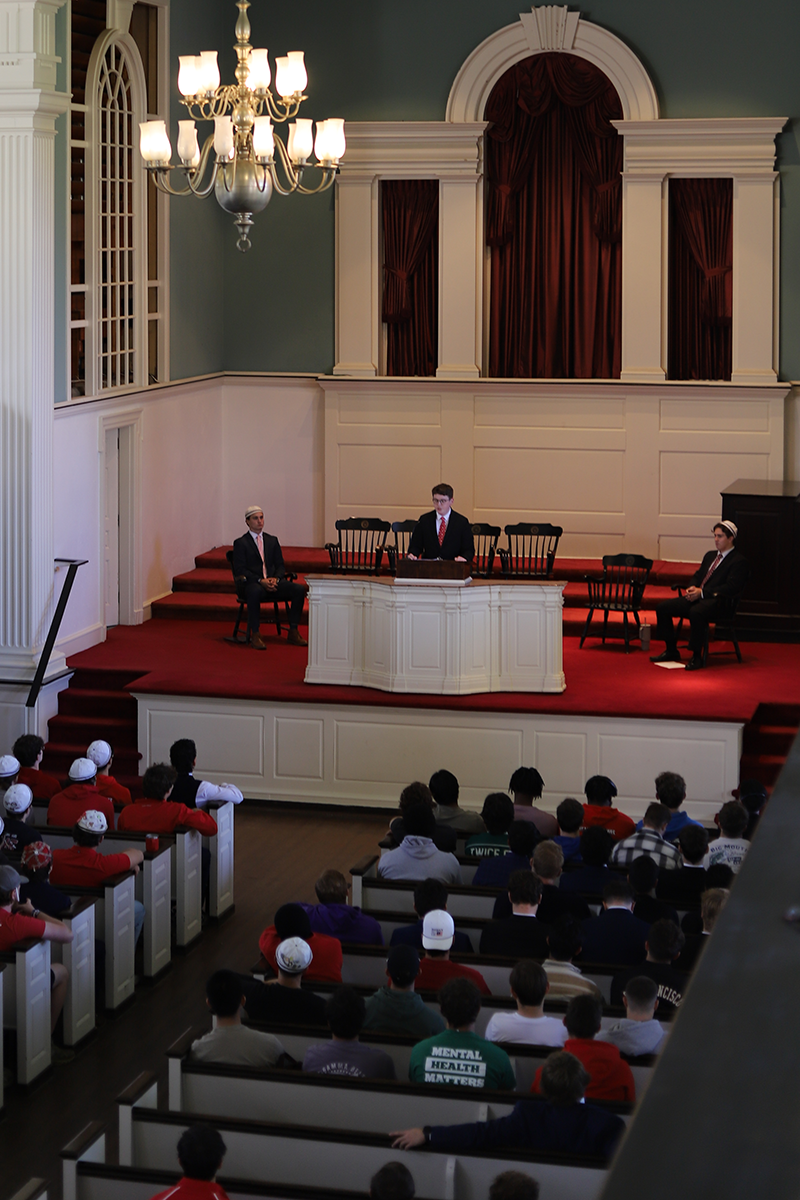
Listening and questioning have proven especially valuable in his leadership roles on campus with sh’OUT. Through conversations with other students, he has focused on fostering a sense of belonging and safety.
“I’ve spoken a lot with queer students on campus, both closeted and out,” he said. “I’ve learned a lot about what belonging is and what makes a person feel like they belong.”
Largent sees a clear throughline between his roles as a student, a teacher, and a campus leader. Whether explaining a difficult calculus concept or listening to a friend’s concerns, he is guided by the same belief—presence matters and people grow when they feel seen and valued.
“I tell students in calculus supplemental instruction, ‘Your presence in our session makes it fundamentally different, and your voice matters,’” said Largent. “And when I run into friends on campus, I try to remember to tell them my day is better because I saw them. Tell someone Wabash is a better place because they’re here. Sometimes that can make the biggest difference.”
After graduation, Largent plans to earn his teaching license and master’s degree, either through Teach For America or University of Indianapolis.