
Sheri Minnick parked her car in front of Center Hall. It was her first time stepping foot on the campus of the alma mater of her husband, Brad Fewell ’86. He did not make the trip from Philadelphia with her this time. After all, this was not Homecoming or Big Bash or a Monon Bell game. Minnick’s reason for visiting was much more serious: a nuclear inspection.
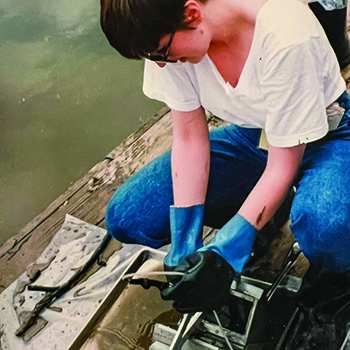 “Believe it or not, the College had, and probably still has, licensed radioactive materials in one of its instructional
science labs. Part of my job at the time was traveling to institutions to ensure those materials were accounted for and safely used,” recalls Minnick. “When I saw Wabash College on the list, I knew it was the perfect opportunity to finally see the campus I had heard so much about.”
That moment marked the beginning of her connection to Wabash—one that would grow in significance in the years
to come.
Minnick and Fewell met as young professionals at the Nuclear Regulatory Commission (NRC), the independent agency responsible for overseeing civilian use of nuclear materials in the U.S.
After graduating from Wabash and earning a law degree from Rutgers University, Fewell planned to work at the New Jersey Attorney General’s office as an attorney. When that job fell through at the last minute due to a hiring freeze,
he applied for a job as an attorney at the NRC on a whim.
Minnick, a Villanova mathematics graduate with a master’s degree in health physics from the Georgia Institute of
Technology, also applied for a position at the NRC because “I didn’t have a job yet and they were hiring all the math and science people like me.”
That chance move set the foundation for their long-lasting marriage and kicked off their careers in the nuclear energy industry.
Minnick inspected and issued authorized licenses for nuclear material as a health physicist at the NRC for 11 years before taking a job at the U.S. Environmental Protection Agency (EPA). There she directed a regional radiation program and worked to establish a credible radiation program at the Department of Homeland Security. She returned to the NRC a few years later to liaise among local, state, federal, and Native American tribal government entities and propose regulations that protect public health and safety. In 2007, she took the role of deputy radiological safety officer at Argonne National Laboratory.
Fewell spent more than a decade at the NRC as an attorney before moving on and rising through the ranks to become general counsel and senior vice president for nuclear security, licensing, and regulatory affairs at Constellation Energy Group, the nation’s largest operator of nuclear power plants.
Fewell says nuclear is the “largest, most effective producer of carbon-free energy generation today.”
Countries around the world are embracing nuclear energy now more than ever—investing in new nuclear reactors
and facilities as they look for efficient solutions to growing energy demands.
But this alternative power source was not always celebrated. Fewell has observed a shift in attitude in recent years.
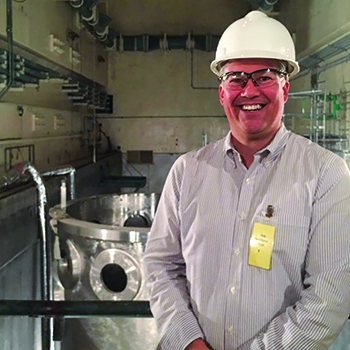 “For a long time, you really didn’t go around telling people you worked in nuclear energy. It was a bit taboo,” he says.
“What we were doing was beneficial to the world, but people associated the word ‘nuclear’ with destruction. People didn’t understand it, so they feared it.”
Perception is changing thanks to improved advocacy, better communication, and broader interest in how human
behavior impacts the environment.
“It has been great to see people, especially the younger generation, open their minds to nuclear power and alternative energy sources,” says Fewell. “That became one of my favorite parts of the job later in my career—speaking with young people who are passionate about sustainable energy and interested in learning more about our work.”
As a Wabash student, Fewell never dreamed of one day dealing with nuclear energy. A psychology and English double major, he wrote for The Bachelor, served as president of Phi Kappa Psi, and was active in student government.
“Nuclear energy and the energy industry at large were not really on my radar at Wabash,” says Fewell. “At the
time, I had my sights set on law school and didn’t know a thing about energy.
“Funny enough, I was also involved in an organization on campus called Wabash SANE that focused on nuclear
weapons disarmament,” he continues. “It had nothing to do with nuclear energy, but it is a weird coincidence.”
After decades of shaping policy and practice in the nuclear field, Fewell and Minnick say bigger things lie ahead.
“We’ve spent our careers helping to build the foundation, but the real story of nuclear energy is still being
written by the generation that’s coming next,” says Fewell.
“Nuclear energy isn’t a perfect solution, but it’s one of the tools the world has to meet its future responsibly,” says Minnick. “That makes the work we’ve done feel worthwhile.”
Brad Fewell ’86 and Sheri Minnick spent their careers ensuring the safety of nuclear energy. Their latest project is about creating opportunity. Through the newly established Fewell-Minnick Scholarship, the couple is opening doors to enable students with financial need to attend Wabash—an opportunity they hope will change a life the same way unexpected opportunities changed theirs.
“Life is all about opportunities,” says Fewell. “I made the decision to go to Wabash and a few years later to apply for a job at the NRC. Those choices shaped my life and my career. We hope our scholarship offers students the opportunity to make the decision to continue their education at Wabash and change their life trajectory.”
The Fewell-Minnick Scholarship aims to empower a Wabash student who needs, as Brad once needed, an opportunity to grow, discover, and make bold choices.
“We are firm believers in a well-rounded liberal arts education,” says Minnick. “A good education can change a person’s life, especially one from Wabash.”
For the Fewell-Minnick family, energy and education are inextricably linked—both powerful forces for change, growth, and a better tomorrow. The couple’s impact does not stop with Wabash. They are also working to establish
a similar scholarship at another institution for women pursuing a liberal arts education.
“Brad and Sheri are amazing, generous people,” says Steve Hoffman ’85. “They are lifelong learners, put education at the forefront, and care about providing opportunities for others. They will be changing lives forever, and I know that means a lot to them.”