
It’s almost like the setup for a joke: How many Wabash grads does it take to change a light bulb?
No one knows, but at least four are dedicated to making sure the bulb turns on when you flip the switch.
Wabash men take many paths after they graduate and go into the workforce.
Joe Motuliak ’05, Blair Littrell ’17, Joshua Powers ’22, and Andrew Wells ’06 never anticipated working in the energy sector, but all followed their skills and passion and found their vocation.
Motuliak majored in economics and, after working with a major mechanical engineering contractor, went to Purdue for his M.B.A. He has spent 15 years in the wholesale energy sector. Wholesale energy companies purchase energy in bulk from producers to resell to customers at a profit. Early on, he was with energy management company ACES, working on the “load side”—managing the demand for electricity and adjusting voltage to stabilize the grid and reduce costs. He eventually moved into the “G&T side” doing generation and transmission cooperative work.
“In 2023, I joined NextEra and did development origination for wind, solar, and battery,” Motuliak says. “We were
starting to do natural gas over the last year or so. Then, I joined Aypa Power, which is really focused on storage.”
After graduating from Wabash, Littrell began looking for work that would give him experience before entering law school. He landed at the Indiana Utility Regulatory Commission (IURC), an administrative agency that oversees utilities in the state and makes decisions in the public interest on rates, finance, and service.
The IURC is mandated by the State of Indiana to hear evidence in cases surrounding public utilities. It does not make policy, but ensures policies are enforced in a way that is fair to energy generators and energy consumers.
Littrell says, “We play a critical role in making sure all Hoosiers have safe and reliable utility service at just and
reasonable rates.”
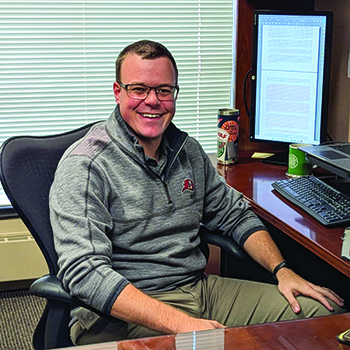 He went back to school—not law school, but graduate school for an accounting degree. He now works on utility rates and spends a good portion of his time reading testimony and checking accounting records.
Powers is a financial analyst with RES Group (Renewable Energy Systems), the world’s largest independent renewable energy company. He majored in economics at Wabash and went on to get his master of science in finance at the University of Colorado. He has spent the past two years supporting the development of renewable energy assets across the United States and Canada.
“RES does not own our assets,” Powers explains. “We’re looking for people who want that diverse portfolio with renewable energy assets that also help offset their carbon footprint. Or maybe they’re trying to get into the market because they see value in it. We’re trying to find places for these people to then develop.
“When we find a development project, the biggest thing we are looking at, from an economic standpoint, is the wind itself, because that’s generating the revenue,” Powers continues. “Then we’re looking at the value of the tax credits we can get. This all informs our project internal rate of return.”
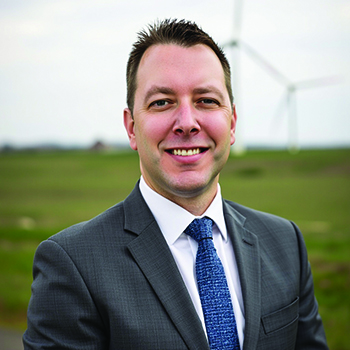
Wells serves as general counsel for Duke Energy Indiana, the largest electric utility in the state. After Wabash, his path took him to the office of then-Gov. Mitch Daniels. During Daniels’ reelection campaign, Wells attended Indiana
University McKinney School of Law. He has experience with private practice, as well as state government as a house lawyer with the Indiana Department of Natural Resources. Following a stint with the IURC, Wells has been with Duke for seven years.
“Duke Energy is the largest electric utility in the country, and we’re the largest electric utility in Indiana,” he says. “We have just over 900,000 customers in 69 counties. Duke Energy Indiana is everything but nuclear, really—we have full natural gas, hydro, solar, wind. It’s not wind generation, but we have some battery storage associated
with that.”
Despite the varied paths these four men took, they all play important roles in discovering and adapting to the evolving energy landscape.
Demand for reliable, flexible energy has never been higher. Data centers and artificial intelligence (AI) infrastructure have increased demand—AI is resource-hungry—while hotter summers have increased strain on power grids around the world.
At the same time, consumers are increasingly conscious of how their power is generated. Added awareness of climate change and conservation has prompted more people to question reliance on fossil fuels and to support wind and solar energy.
“Even companies whose bread and butter has been oil and gas are transitioning to renewables,” Powers says. “They see it as a better market right now.”
The biggest factor, all four agree, is reliability.
“I have always been pretty agnostic about how power is generated,” says Motuliak. “We need a diversity of supply.”
“Base load,” the minimum demand on a power grid, is one of the main factors in energy generation.
“We don’t care how we get the base load, but it’s got to be reliable,” he continues. He goes on to point out that load growth—the increasing demand for energy—had been relatively stable, around 2% a year, since the late 2000s.
That has changed exponentially in the past two years.
“Most of this load growth is data center driven,” Motuliak says. “The power demand is not going away.”
Ppower demand can be met in many different ways, and recently, energy companies have shifted from fossil fuels
into a diverse and balanced mix of sources.
 “No one is going to build new coal plants,” Wells says. “But you’ll see some of the older coal plants get extended lives. They’ll still have to comply with the environmental regulations in the books.”
He points out, though, that there are better alternatives to coal at this point. “Nuclear is more able to generate energy efficiently.”
Littrell agrees.
“Nuclear assets are very expensive to build,” Littrell says, “but they have long, long lives, and they’re only down when they refuel. Nuclear fuel is very stable.”
Nuclear seems to be the refrain when speaking with experts in the industry. Other Wabash alumni have taken note. Indiana Gov. Mike Braun ’76 announced he is pushing for nuclear development in Indiana.
“Indiana’s legislature has moved legislation in the last handful of years to try to make it easier for nuclear,” Wells adds. “It seems the federal administration is also making some similar efforts.”
Other forms of clean energy, such as wind and solar, aren’t met with the same sort of enthusiasm.
“A lot of times, with wind and solar facilities, their lives aren’t as long as a coal or gas plant,” Littrell says. “When they build a new coal plant, they expect this asset to live over 35 years. Wind assets typically live perhaps 20 years.”
Wind and solar are also much less dependable, on a utility scale, than nuclear and natural gas.
“‘Nameplate capacity’ is how much, in theory, we’re going to provide to the grid at any given time,” Littrell explains. “A nameplate capacity of, say, 150 megawatts might be the absolute best-case capacity, but the wind doesn’t always blow.
“‘Accredited capacity,’ as opposed to nameplate capacity, is how much you can reasonably expect that capacity to be. Using the 150 megawatts example, that wind facility may have an accredited capacity of 15% of that, so 22.5 megawatts. They provide amazing energy value, but the capacity value they provide is much less than a thermal
resource (such as coal or nuclear).”
Motuliak says battery construction is essential for wind and solar development. Although the battery sector is relatively new, it’s making a huge difference.
“You’ve probably heard the term ‘intermittent resources,’” Motuliak says. “Obviously, they don’t always work, because the sun’s not always shining and the wind is not always blowing. We have a lot of times during the day where either wind is outpacing demand or solar is, so batteries have filled that void. In the middle of the night, when the wind’s blowing and everybody’s asleep, what we don’t need in the grid we can now use to charge, and we can store it for the middle part of the day when everything’s ramping up, and discharge it.”
These batteries resemble a more aesthetic version of a shipping container and operate the same way a cell phone battery operates. They can store and hold large capacities to discharge during peak hours, evening out the load.
The transition from fossil fuels requires workforce and economic adjustment, neither of which happens easily or quickly.
Powers emphasizes that the work he does with RES is addressing some of those concerns.
“There are jobs lost because of the loss of fossil fuels, so we’ve been moving into those regions,” he says. “We’re trying to replace as many jobs as we can from any coal closures.”
There are also larger community-wide impacts of this shifting energy landscape. Motuliak points out the economic impact of starting an energy project.
“You’re seeing areas that historically have had a coal plant close that carried a lot of the tax base for that community,” Motuliak says. “These new projects can come in and, again, provide tax revenue for decades. There’s a lot of benefit out there that goes beyond what people see.”
Powers agrees that the utility-scale projects his company works on can become huge assets to the community.
“We have to spend a lot of money to get those operational, especially in property taxes,” he says. “Those facilities generate millions of dollars of property tax for a county.”
Yet those projects are often met with resistance. Wind farms and solar developments are protested, often by rural
landowners who don’t want to see farmland taken out of production.
When Motuliak was working at NextEra, he was involved with a solar project that received a lot of pushback.
“People are all for property rights,” he says, “but the minute they think any of that is going to impact them, now we’ve got an issue.”
Ultimately, when the permitting on NextEra’s solar project failed to go through, the project was pivoted from solar to
battery storage.
“I don’t know why a local community is going to tell a farmer what they can do with their land,” Motuliak says. “They basically force them to continue doing something either not productive or very volatile, as the commodity markets are. With solar, these farmers can sign long-term lease agreements where they’re getting stabilized payments for
25 or 35 years.”
Littrell can see both sides of the issue.
“I get it to some extent,” Littrell says. “You buy your house, then this construction starts next door, and all of a sudden you feel like you can’t enjoy your property.”
He says developers are increasingly working on outreach to emphasize they are not trying to invade, but trying to become a part of the community.
“I have found those projects to be more successful,” he says.
Ultimately, Littrell thinks electricity consumers should spend time educating themselves about what goes into establishing price rates, regulations, and incentives.
“Understanding how our process works is going to be very valuable when people think about energy policy, when they go to vote, and think about what they want from their representatives and their decision-makers on energy policy,” he says. “Understand the role of state commissions, whether you live in Indiana or not, every state has a utility commission like us. We all do the same work, and we’re all focused on energy policy.”
Overall, the energy outlook is bright. Tax credits for the renewable energy market through 2028 mean the potential for lots of renewable projects in the next three years.
“Between now and 2028 there’s going to be a flood of renewables trying to get into the market,” Powers says. “Post-2028 there will be a sharp decrease.”
“We’re seeing load growth that I don’t think we’ve seen in this country since World War II,” Motuliak says. “Over the next five to 10 years, there’s going to be a mad rush to build solar and wind in particular, to get these projects online. Everybody’s looking at natural gas, but that’s not going to get built or permitted really quickly, so that’s maybe 2030 or 2032, if you didn’t already have it in the works.
“I’m pretty positive we’ll have a good five- or seven-year run here,” Motuliak continues. “And I’m sure things will evolve during that timeframe.”
There are challenges, however.
Determining fair rates for all customers can be difficult, whether the customer is a homeowner wanting to do his laundry or a data center wanting to process thousands of inquiries an hour.
“Do you want your residential customer paying for a power plant that was needed to power an AI data center?” Littrell asks. “These are conversations we’re having every single day, how to structure these things, what’s the right way to do it.”
Demand is anticipated to continue growing, especially as AI integration is added to more and more aspects of life.
Wells compares the increased demand to the 1960s and 1970s, when much of the United States began relying on air-conditioning in buildings.
“The biggest challenge right now is just being able to build it fast enough,” Wells says. “We’ve entered a period of dramatic load growth, basically driven by data centers, AI, and crypto. That’s a lot of megawatts to come on the system.”
Powers remains optimistic.
“I’m reassured by people who’ve been in our industry for 20-plus years,” he says. “They’ve seen these tax credits almost sunset three or four times, but every single time, right before it sunsets, it comes back.”
Littrell knows that their collective efforts are significant.
“It’s critically important, the work we do, and it helps me get up every day knowing what I do is going to affect peoples’ lives,” he says. “There’s not a day I don’t feel like I’m doing something that’s critical for society.”