
Dressed in cargo pants, a Carhartt ball cap, and cracked work boots, Justin Harmeson ’18 walks Clegg Memorial Garden in Lafayette, the headquarters property of NICHES Land Trust (Northern Indiana Citizens Helping Ecosystems Survive), where the Attica, Indiana, native acts as stewardship manager.
“There are intersections with history and geology, how soils affected the plants that are growing there,” Harmeson says as he points out a Virginia spiderwort growing alongside the trail. “You have to be a botanist, a community advocate—and when you’re in the field, a small-engine mechanic, a tree cutter.”
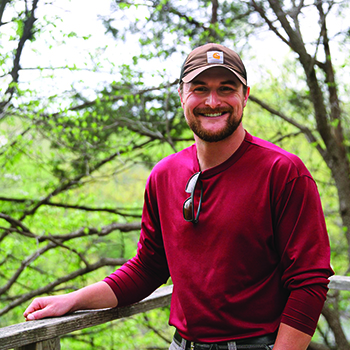 Hiking down the side of a ravine covered in wildflowers, Harmeson talks about his work since graduating from Wabash while narrating the species in the landscape. It’s hands-on work that includes invasive species removal, tree
thinning, and prescribed burns, but it also requires someone adept at communicating with people from all walks of life.
While his liberal arts education prepared him well for this work, a lot of his knowledge has also come from hands-on experience in the field, whether he is deciding which trees belong in an upland forest or pulling invasive garlic mustard.
“That’s the cool thing with this job: There is always something to learn,” Harmeson says. “I was talking with the state botanist today and frantically making notes of new plants and stuff to look up later. I’m always learning things at a species level but also learning how we can improve the work we do.”
NICHES serves 13 counties in Indiana. Most of their properties are open to the public, including Clegg Memorial Garden in Lafayette and Bachner Nature Reserve and Walnut Fork Wildlife Refuge in Montgomery County.
Harmeson, who was a member of the Outdoorsman Society at Wabash, originally thought he would be a wildlife biologist. During a 2017 internship with NICHES, he realized he could manage the entire landscape instead of just wildlife. Since then, he has blazed a trail dedicated to stewardship, connection with nature, and ecological management.
“A lot of this job is trying to read the landscape,” he says. “Understanding the plants, animals, and insects and what
they’re telling you, which affects the type of management we do.”
At the same time, he adds, “The critical thinking skills I learned at Wabash really get brought into this job, because I’m trying to take the whole natural world and put it within the human lens and how we can actively manage that.”
The human effect on land management is something Harmeson thinks about daily.
“Indigenous Americans played a really important role,” Harmeson says as an eastern phoebe flits through the trees. “They don’t get the recognition they deserve for protecting and living within the landscape. Then colonization essentially started changing our landscape. When you throw in climate change and habitat fragmentation with agriculture, it gets to be a lot.
“An average day involves invasive species removal. In the spring and fall we do prescribed fire; in the winter we’re doing sugar maple thinning,” he continues. “Mix in volunteer work days and training seasonal staff, and then in
the fall, we have our hunting program.”
The hunting project is particularly near to Harmeson’s heart.
“That’s how I first got involved with the natural world,” he says. “I find a lot of gratification showing those hunters why we’re doing this work. Then they invest in the mission. We have about 160 folks that hunt across our land. Those people volunteer about 20 hours a year. This past year, they put in around 4,000 hours on the land, so we’re getting something from them on top of the work of just reducing the deer population.”
Once Harmeson has a relationship with fellow hunters, he works to instill a feeling of ownership of the public lands
NICHES is preserving. That’s why he says a lot of his work as a land steward is in building relationships.
“Hunting is great, fishing is great,” he says, “but that holistic connection—understanding the landscape—is really
when you get that passion for it and want to protect it for future generations.”
This past spring at the 2025 Awards Chapel, Harmeson was awarded the Thomas A. Cole Alumni Prize in Biology. The prize is presented to the graduate who is doing outstanding work for the fields of biology, environmental science, or medicine.
“What applied to Justin, of course, was that word ‘outstanding,’” says Associate Professor of Biology Brad Carlson. “Justin found a niche in connecting his own background as a hunter and fisherman from a small town to this broad liberal arts education. He found his unique path and blossomed into someone his organization relies on.”
Carlson, who currently serves on the NICHES board, knows Harmeson not only as a student but also as a colleague. He emphasizes how important Harmeson’s work is.
“I’m increasingly of the opinion that—and I say this as a scientist—we don’t necessarily need more science,” Carlson says. “We don’t necessarily need more information to be discovered; we just need people to do something with the information we have. We already know enough to solve a lot of these problems, but the problem is getting people
to respond to that and take action.”
Carlson takes Wabash classes to multiple NICHES properties during the school year. He says getting people to take action is exactly what Harmeson is doing.
“Justin’s work builds those connections,” he says. “He’ll continue to spread the word and build support among people in the area.”
Harmeson’s job isn’t without its challenges. As a small nonprofit, NICHES relies heavily on donations and memberships, as well as people who donate land or sell it at a bargain rate. Climate change, habitat fragmentation,
and historical land use changes have significantly altered the ecosystems NICHES is dedicated to preserving. The four stewardship staff members manage nearly 5,000 acres across 11 counties.
But Harmeson isn’t giving up.
“I’m really excited about the amount of opportunity,” he says, pointing at a hillside of Virginia bluebells. “We can’t go back to the past. We have to understand where this property is, and how we can best manage to promote this moving forward. I’m really excited about the future of the organization and how our work looks.”
Hill’s thistle population on Nature Conservancy property was becoming genetically bottlenecked. Through
Harmeson’s research and local partnerships he built, a population of the state-endangered plant was
discovered in Sand Ridge Cemetery in Tippecanoe County. The township agreed to collect seed, which NICHES
planted at the Granville Sand Barrens. Now, instead of five populations, there are six, and one of the previously
existing five has had genetic improvement. Without Harmeson’s action, the Hill’s thistle might have been extirpated from the state. “It’s a NICHES success story,” Harmeson says. “You’ve got to stay positive.”