
In 1954, Bell Labs introduced the first silicon-based solar panels, which produced power five times more efficiently than previous models that dated back to the 1880s. In a front-page story, the New York Times called the invention
“the beginning of a new era, leading eventually to the realization of one of mankind’s most cherished dreams: the harnessing of the almost limitless energy of the sun.”
Since this breakthrough, the solar industry has innovated, improved efficiency, lowered costs, and grown this technology into an essential part of the energy system—a solution that is renewable, carbon-free, and reduces society’s reliance on fossil fuels. According to the U.S. Energy Information Administration, as of 2023, solar accounted for more than 50% of new electricity-generating capacity added to the grid and employed more than 260,000 Americans, including several Wabash alumni.
“I was very lucky that my parents exposed me to some pretty incredible natural environments traveling as a kid, so I understood from a young age that we do our part to protect nature,” says Ty Benefiel ’10. “It wasn’t until I was older that I realized climate change jeopardizes more than just the beauty of nature; it’s a real threat to humanity and society. Once that hit home for me, I decided, Why don’t I try to do my part?”
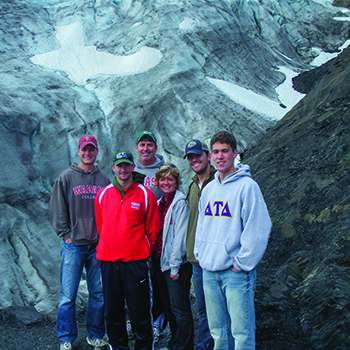 Following graduation from Wabash, the economics major and history minor attended the Kellogg School of Management at Northwestern University. There, he and a few fellow students launched Meter Genius, an app that helped consumers understand their energy consumption and save money by tailoring their usage.
After selling the app in 2020, he teamed up with his dad, Kevin Benefiel ’81, who had recently retired from his role as vice president of Dr. Pepper. Combining Kevin’s network in the restaurant business with Ty’s interest in the clean energy industry, the father-son duo launched Integrate Solar to empower businesses to harness solar power and reduce energy costs.
During his time at Dr. Pepper, Kevin worked closely with quickserve restaurants, many of which spend more than $100,000 per year on utility bills. To offset this monetary cost and environmental impact, Ty developed solar canopies that generate power while providing shade and sun protection over drive-throughs, patios, and parking lots. Today, Integrate Solar’s canopies can be found at more than 150 locations in partnership with major brands like Starbucks, Chipotle, and Taco Bell.
“The solar industry is stronger than it’s ever been,” says Kevin. “The cost of solar is cheaper than ever, and more
and more people are realizing the negative economic, health, and climate impacts of fossil fuels—so the demand
for solar is greater than ever.”
According to the National Renewable Energy Laboratory (NREL), the U.S. Department of Energy’s primary national laboratory for energy systems research and development, there were 64%, 69%, and 82% reductions in the cost of residential, commercial-rooftop, and solar farms, respectively, between 2010 and 2021.
Although there is a burgeoning market today for high-tech innovations like Integrate Solar’s onsite solar canopies, Wabash graduates have long been exploring sustainable power and solutions.
In 1978, Dick Durham ’64 saw an ad for a Florida-based company specializing in active solar—systems that use mechanical components like pumps and fans to transfer solarcollected heat. This kicked off his career of installing and educating on green energy.
Durham installed a couple hundred solar-powered domestic water heaters in homes. Then, he connected with an
Massachusetts Institute of Technology graduate in Colorado who had created a “breadbox” solar heater—a simple
design that utilizes an insulated tank and a dark transparent cover to capture solar energy and heat the water inside.
“I sold about 300 of those, and believe it or not, after 40 years they all still work!” he says with excitement.
A longtime champion of conservation and sustainability, Durham faced his fair share of skepticism and misinformation regarding solar power.
“The biggest hit was when Consumer Reports came out in the 1980s saying that solar does not work. It really
tainted the water for a long time,” says Durham. “So, I started trying to educate people on what works. I’d have
solar parties at our house and show them, ‘Hey, look at this. This is our electric bill. Wouldn’t you like a bill like that?’”
Daniel McCarthy ’20 approaches many conversations with landowners the same way. The Chicago-based project developer for Sol Source Power often says, “OK, you’re hesitant. Why are you hesitant, and what can I do to reduce that hesitancy?”
“A lot of it comes down to a lack of information about what solar is and what it does. A lot of people hate wind and associate solar with it,” says McCarthy. “But solar energy is not wind.”
Kevin Benefiel agrees that one of the greatest hurdles in his work is educating customers on the financial benefits of solar energy in addition to sustainability.
“The solar panels that we use will generate power for 30 years or more, and many of our customers pay off their solar canopies in five years or less. So, essentially, you are getting 25-plus years of free electricity that’s generated
by the solar canopies,” Kevin says.
Ty Benefiel argues that further development of batteries—which store energy for use when the sun isn’t shining—will be critical to unlock the full potential of solar as a dominant force in both domestic and global energy.
“We are going to see with batteries the same kind of cost reduction and efficiency improvements that we saw with solar. You’re going to see the price of batteries drop 90%, and you’re going to see the efficiency probably double; and when that happens, you’re going to see a real decisive shift to clean energy,” he says.
Now 15 years out of college, Ty reflects on how his time in the classroom shaped his view of the world and his career path.
“As a Wabash student, it was instilled in me this idea of trying to think critically and act responsibly. I can’t think of a better industry that lives up to the ideals of Wabash than the clean energy industry,” Ty says. “Whether you care about the planet, the health outcomes of your community and your loved ones, or profit, the solar industry has a place for you.”