
Zamir McNeal ’29, who hopes to be a history major and double minor in Black studies and biochemistry or music, has spent nine years singing with the Birmingham Youth and Young Adult Fellowship Choir (BYYAFC). Founded in 2015 by choir director Ahkeem Lee, the group brings together singers ages 8 to 28 to share the gospel through music. McNeal joined in 2016 and gradually took on more leadership and performance roles as the choir grew.
When videos from the choir’s 10-year anniversary concert went viral in 2024, America’s Got Talent (AGT) producers took notice. They invited the group to audition, setting off an exciting and hectic period of uncertainty.
 “There was a lot of back and forth,” McNeal said. “At one point, we weren’t going to fly out to audition because they weren’t going to let us do a gospel song, but that’s what we do. We are a gospel choir and our whole mission is to help young people proclaim the gospel by developing their musical talents. They eventually understood and allowed us to sing our music.”
At the same time, McNeal was finishing his senior year of high school and preparing for college. In early 2025, he traveled from Birmingham, Alabama to Crawfordsville, Indiana as a Lilly Scholar Award finalist.
“I came to Wabash, did my thing, flew home to Alabama, went to school, went to prom that Friday night, and caught a red eye flight to Los Angeles early the next morning for the AGT audition,” he said.
The choir’s audition took an unexpected turn when notoriously tough judge Simon Cowell hit the golden buzzer, sending BYYAFC directly to the voting rounds.
“When we got the golden buzzer, I could do nothing but praise God,” said McNeal. “We honestly never would’ve gotten there without him. We could tell it was one of those things that he orchestrated because, we told them we couldn’t go if they wouldn’t let us do gospel music, and they ended up letting us do it. We did it, and we got the Golden Buzzer. If that wasn’t a sign, I don’t know what is.”
The moment was emotional.
“A whole bunch of us, immediately put our hands up, praising,” he said. “Tears falling down our eyes. I’m picking up confetti and stuffing it in my overalls pockets like, ‘I gotta stop crying.’”
The audition taped in March, but the choir had to keep the result a secret until July.
The episode aired while McNeal was on campus for the Wabash Liberal Arts Immersion Program (WLAIP).
“Some guys in the WLAIP were like, ‘Put it on. Let us see you watching it back from this point of view,’” McNeal said. “I had a big old grin on my face when I saw us get the buzzer again. I’m like everyone else, just in awe. Still, at this moment, I can’t believe we went there and did that.’”
In August, McNeal moved into his dorm room. Classes started on Wednesday, and he flew back to Los Angeles the following Tuesday to prepare for the live shows.
“That’s another reason why I love Wabash,” he said. “That first week of classes, I kept reminding my professors that I wouldn’t be here week two of class, and maybe week three if we advanced. Wabash did everything in its power to support me and make sure I got to the airport. Dr. Horton was outside of my living unit with a car.”
McNeal said exhaustion from travel and late-night rehearsals faded once the group stepped onstage.
“The feeling of that standing ovation,” he said. “Mel B was saying we took her to church. Howie could only say he was speechless. We rocked it.”
The next day, BYYAFC learned it had earned enough votes to advance.
“At this point, I’m both excited and stressed out,” said McNeal. “I’m like, okay great, we get to move forward. But now I have to email four different professors and my advisor to let them know I’m going to be out here another week.”
From LA, McNeal kept up with his coursework, staying in touch with faculty and Associate Dean of Students Marc Welch.
As soon as the group advanced, the clock started running—four days to arrange, rehearse, and record the next performance.
“Everybody has four days to get a full performance together. We basically have 92 hours to learn a song and arrange harmonies, choreography, wardrobe, even just how we’re going to walk out there.”
Child labor regulations limited rehearsal hours for younger choir members, so McNeal and the older singers worked late into the night to arrange the next song and prepare to teach it to the rest of the choir in the morning.
One night, their sound engineer delivered unexpected news: “By the way, Alicia Keys gave you special permission to use her song.” The group transformed “No One” into a gospel piece.
BYYAFC’s AGT run ended at the quarterfinals, but McNeal said the experience fulfilled the choir’s mission.
“We weren't even there simply to win. We were there just to be there and share our music. That was our purpose,” he said.
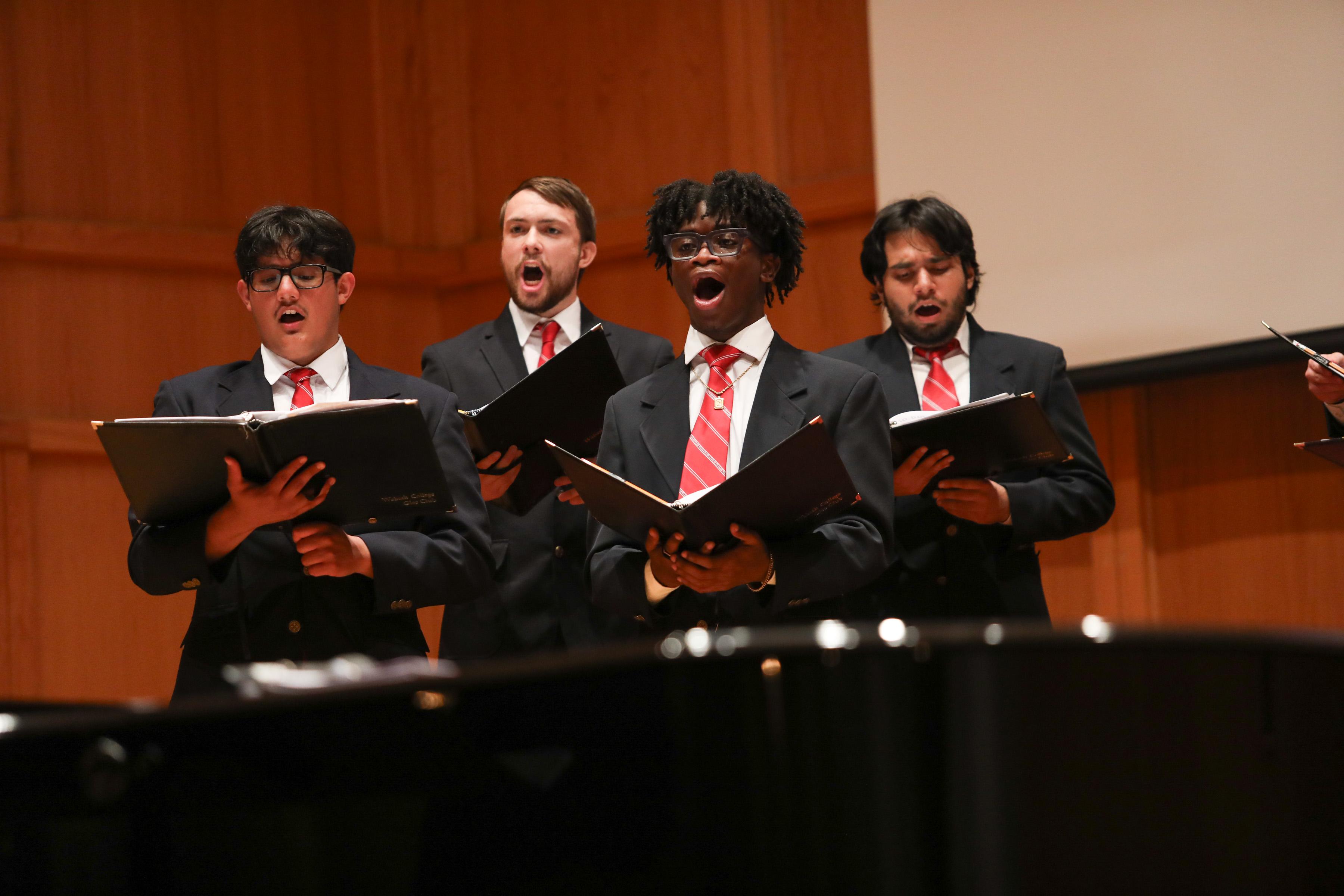
Describing gospel music, McNeal spoke about the feel as much as the sound—the blend of rhythm, soul, and resonance that moves people. He hopes to share some of that spirit with the Wabash Glee Club.
“Gospel music is gorgeous,” he said. “Even if we didn’t sing gospel songs but added that rhythmic, soulful, melodic feeling in certain songs, I think it would draw the student body in and probably grow the Glee Club.
“My vision isn’t to change the sound, but to grow it,” he continued. “And I’ve been thinking about how I can do that with other things I join on campus. What are some ways to not change it, but add to it? What can I bring to the table?”
Almost one semester complete, McNeal is seeking opportunities to contribute to campus culture. Glee Club Director Juan Hernández said McNeal’s enthusiasm for music is already evident and infectious.
“Zamir's love for music shines through every time I talk with him,” he said. “He's always humming riffs or singing a melody that's stuck in his head, and I genuinely enjoy hearing about the music he's excited to sing. His warm, friendly presence brings so much positivity to the Glee Club, and I always appreciate the energy he adds to the room. We are fortunate to have a singer like Zamir; the joy he brings is uplifting!”
Music is the metaphor McNeal uses to make sense of his journey.
“When I turned 12, life modulated like a jazz chord,” he wrote in a recent essay. The idea, he explained, comes from the unexpected moment of dissonance in jazz—a sudden shift, uncomfortable at first, that eventually resolves.
“That dissonance in life—maybe it’s a car accident or something as little as your phone cracked—that modulation, and it feels like everything is falling apart,” he said. “But toward the end of the song, the saxophone and the piano and drums all sync up and everything falls back together.
McNeal’s past year has included several of those jazz-like modulations, but he said the melody is just unfolding.