
James Makubuya
Associate Professor of Music
CONTACT:
Fine Arts Center M121
765-361-6474
makubuya@wabash.edu
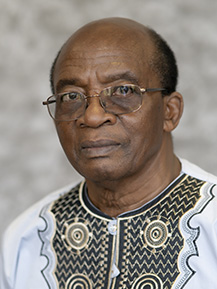
Dr. James Makubuya joined the Music Department at Wabash College in July 2000, and his impact on the department has been strong and positive. At Wabash, he started the World Music program that included a number of new World music courses and Wamidan, the World Music Performance ensemble. In addition to endongo (8-string bowl lyre) as his main instrument, Dr. Makubuya is proficient in several other East African traditional instruments including tube fiddles, bow harps, thumb pianos, xylophones, panpipes, flutes and drums. Dr. Makubuya's geographical area of research is East Africa with a focus on organology and cultural context of music. He is an active participant in national and international professional societies including the Galpin Society, International Council for Traditional Music and Society for Ethnomusicology. As a professional musician, James has performed in Carnegie Hall, Eastman School of Music, Brooklyn Academy of Music, etc. A recording artist as well, James has been featured in several documentaries and six studio CD publications.
EDUCATION
University of California, Los Angeles, CA. Ph.D. (Ethnomusicology), 1995
Catholic University of America, Washington, DC. M. Mus. (Western Music / Music Education), 1988
Makerere University, Kampala, Uganda. B.A. (Music, English Literature), 1980
RECENT COURSE OFFERINGS
MUS 056/156 - Wamidan World Music Ensemble
MUS 102 – World Music
MUS 202 – Instruments and Culture
MUS 204 – Music in Asian Cultures
MUS 224 – Global Perspectives on Music Cultures and Identity
MUS 287 – Independent Study
MUS 201/301/302 – Musicianship
MUS 313 – Seminar in Music History
Freshman Tutorial
RECENT PRESENTATIONS
2013
November 14-17. At the Invitation of the national organizing committee of the Society for Ethnomusicology which I was part of, I directed Wamidan – the Wabash College World Music Performance Ensemble – that presented a 60 minute concert performance at the Annual Conference of Society for Ethnomusicology. This took place in Indianapolis, IN.
October 25-27. Presented a paper at the Africa Network annual conference that took place at the University of Denison, Granville, OH. As one of the 6 presenters on the panel the theme of which was “Teaching About Africa at Wabash College: A Multidisciplinary Approach,” my 15 minutes presentation was entitled, “Understanding Africa Through Music and Dance.”
October 16. At the Invitation as a Guest Speaker by NAfME - the National Association for Music Education (Chapter), I travelled to Ball State University at Muncie, IN. At their annual Chapter Collegiate conference, I presented (i) a 60 min Guest Lecture on the topic entitled, “Conducting Ethnographic Fieldwork Research”; then I conducted (ii) a 90-minute Workshop and Master Class on the pedagogical approaches for “Folk Instrumental Music, Song and Dance” using East African folk music types as case studies.
September 14. At the Invitation of the California Museum of Making Music, I traveled to Carlsbad, CA and participated in the then on-going “Harp Exhibition.” My participation that included: (i) Presenting a 45 minute Lecture followed by (ii) a 45 minute Concert Performance were based on the topic, “The Adungu Bow Harp: Its Origins, Development, and Innovations.”
August 23. On returning from the Ethnographic field research project I conducted in Uganda, I used PowerPoint presentation and summarily shared my research findings in this year’s Ides of August event– An annual Wabash Faculty research-related presentations forum. The topic of my presentation was entitled, “The Hocketing Aerophones: The Analytical Examination of their Multi-directional Music-Cultural Significance.”
July 8 –August 8. On receiving a 2nd New Development Initiative (NDI) Grant from the Great Lakes College Association, I traveled to East Africa and conducted Phase II of an Ethnographic Fieldwork on “Advanced Building of Folk Instruments: Aerophones Focus.”
May 19-June 2. On receiving a Mellon Grant, I traveled to the University of Hawaii and participated in Part I of the East-West Center “Seminar on Asian Studies.”
April 1. Contributed a Chapter to a Festschrift in Honor of Dr. Jacqueline Cogdell DjeDje. The Chapter I contributed is entitled “The Kiluka Chordophones: Their Sonic and Non-sonic Cultural Significance.” The Festschrift is entitled Resiliency and Distinction: Beliefs, Endurance and Creativity in the Musical Arts of Continental and Diasporic Africa. (Edited by K.L. Browne and J.N. Kidula). Point Richmond, CA: MRI Press, 2013.
2012
October 11-13. I attended the 66th Annual RMMLA – Rocky Mountain Modern Language Association – Convention?in Boulder, Colorado. Serving on the panel of four presenters that addressed the theme entitled Designing and Teaching Interdisciplinary Courses, the paper and topic I read and discussed at this conference panel was entitled "Instruments and Cultures: An Interdisciplinary Integration of Art, Design, Ethnomusicology and Physics."
August 17. Using PowerPoint presentation, I read a paper during this year’s Ides of August – An annual Wabash Faculty research-related presentations forum. My presentation was entitled “Instruments and Cultures: An Undergraduate Interdisciplinary Course Covering Arts and Sciences.”
July 2-August 9. When I received a New Development Initiative (NDI) Grant from the Great Lakes College Association, I traveled to East Africa and conducted Phase I of an Ethnographic Fieldwork project on “Advanced Building of Folk Instruments with a focus on Chordophones.”
2011
March 1. Wrote and sent a 1248-word article to EPMOW – the Encyclopedia of Popular Music of the Word. The East African popular music genre I wrote about and sent to EPMOW is entitled “Kadongo-kamu” due to appear in this year’s encyclopedia series.
2010
November 11-14, at the 55th Annual Conference for the Society of Ethnomusicology, Los Angeles,CA., I read a paper and served on the panel with the theme, "African Music in the American Academy: Challenges and Directions."
November 8-9, at the 50th Anniversary AlumniSymposium for the UCLA Ethnomuscology Department, Westwood, CA, I presented, read a paper and discussed my research findings with regard to "The Effects of Bi-musicality in Ethnomusicology Fieldwork."
August 6-8, during the summer weekend, I participated in the Santa Fe Chamber Music Festival in New Mexico. I did that by playing the adungu (9-string bow harp), and endongo (8-string bowl lyre), in collaboration with Wu Man on the pipa (Chinese lute), Lee Knight on the Applachian banjo and musical bow, as well as Julian Kytasty on the bandura (Ukranian lute).
July 12, at the Lew Wallace Museum, Crawfordsville, IN., , I directed a whole day's Summer Workshop for elementary and high school students. I exposed and introduced them to basic performance skills on African drums and the Aije (harvest) community dance of the Acholi people.
April 15-17, at the Annual Africa Network Conference, Denison University, Granville, OH., I presented and read a paper, "Building Courses on Africa in the Humanities and Fine Arts."I also served as a panelist on the same panel.
January 22, at the invitation of the Eastman School of Music, University of Rochester, New York, USA, I performed a concert on three musical instruments. The three included: endongo (8-string bowl lyre), adungu (9-string bow-harp), and endingidi (1-string tube fiddle). In this concert, I collaborated with Wu Man playing the pipa (Chines lute), and Lee Knight playing the Appalachian banjo and musical bow.
RECENT PUBLICATIONS
Mweesiima. Uganda Martyrs. Recorded by Siteaw, Inc., and Mike Perry of Lightining Struck Studios Clayton, IN (2010)
Mapeera. Recorded by Siteaw, Inc., and Mike Perry of Lightining Struck Studios Clayton, IN (2010)
Dreaming. Recorded by Siteaw, Inc., and Mike Perry of Lightining Struck Studios Clayton, IN (2009)
Wu Man and Friends. Produced by Harold G. Hagopian. Recorded and published by Traditional Crossroads Record. New York, NY. (2006)
Watik, Watik. Fourteen pieces. Published by the Latitudes Record Label. Charlotte, NC. (2000)
“Endingidi (Tube Fiddle of Uganda): Its Adaptation and Significance among the Baganda.” The Galpin Society Journal, Vol. LIII, (2000), pp. 140-155.
“The Ndongo Bowl Lyre of the Baganda of Uganda: An Examination of its Sonic Properties,” African Music. Journal of the International Library of African Music, Vol. 7, No. 4 (1999), pp. 22-28.
Taata Wange (My Dad). Fifteen pieces. Recorded and Published by Infinite Sound Studio and Samite Artistic Productions, Ithaca, NY. (1997).
MAJORS & MINORS
AT WABASH
- Accounting (pipeline)
- Art
- Asian Studies (minor)
- Biochemistry
- Biology
- Black Studies (minor)
- Business (minor)
- Chemistry
- Classics
- Computer Science
- Economics
- Education Studies (minor)
- Engineering (dual-degree)
- English
- Environmental Studies (minor)
- Financial Economics
- Film and Digital Media (minor)
- French
- Gender Studies (minor)
- German
- Global Health (minor)
- Greek
- Hispanic Studies
- History
- Humanities
- Latin
- Law (pre-professional)
- Mathematics
- Medicine (pre-professional)
- Modern Languages
- Music
- Neuroscience (minor)
- Philosophy, Politics, and Economics
- Philosophy
- Physics
- Political Science
- Psychology
- Religion
- Rhetoric
- Spanish
- Theater