
Robert L. Foote
Professor of Mathematics & Computer Science Emeritus
CONTACT:
Goodrich Hall 107
765-361-6429
footer@wabash.edu
Curriculum vitae
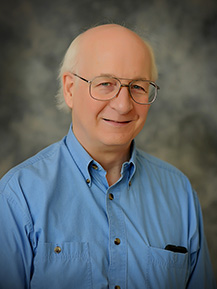
I received my B.A. from Kalamazoo College and my M.A. and Ph.D. from the University of Michigan. I began my career at Texas Tech University, but I came to Wabash in 1989 after deciding I would rather spend my career at a quality, small liberal arts college.
My primary research area is geometry, specifically differential and integral geometry, and generalizing results from Euclidean geometry to spherical and hyperbolic geometries. I have also done work in several complex variables and control theory. Some of my research projects in spherical and hyperbolic geometries include pendulum dynamics, perimeter formulas for convex regions, how volume is generated by a moving surface, isoperimetric inequalities, and a favorite ongoing topic, how planimeters work. For details, please see my personal web page and vita.
For fun I play trumpet in the Wabash College Brass Ensemble and the Montgomery County Civic Band, I bicycle the county roads near Crawfordsville, and I make bowls and ornamental objects on my wood lathe.
EDUCATION
Ph.D., Mathematics, University of Michigan, April 1983
Dissertation: Curvature Estimates for Monge-Amèpre Foliations
Thesis Advisor: Daniel M. Burns Jr.
M.A., Mathematics, University of Michigan, April 1978
B.A., Mathematics, Kalamazoo College, June 1976
Magna cum Laude with Honors in Mathematics, Phi Beta Kappa
Heyl Science Scholarship
RECENT COURSE OFFERINGS
MAT 106: Topics in contemporary mathematics with an emphasis in geometry, a.k.a. “Symmetry, Shape, and Space”
MAT 111 & 112: Calculus I & II
MAT 221: Geometry
MAT 223: Linear algebra
MAT 224: Differential equations
MAT 225: Multivariable calculus
MAT 333: Functions of a real variable, a.k.a. real analysis
MAT 377: Special Topics: Differential geometry
The courses I enjoy teaching the most are the two geometry courses and multivariable calculus, since they are the most geometric-oriented of the courses we have. When I teach MAT 221, I take an approach that develops Euclidean, spherical, and hyperbolic geometries in parallel. MAT 106 is a “hands-on” course. Students work in groups and frequently explore geometric topics using linkages, mirrors, compasses & straightedges, and Styrofoam spheres and string. Multivariable calculus is a combination of calculus, linear algebra, and geometry that is the foundation of differential geometry, much of applied mathematics, and the mathematics used in science, engineering, and economics. I have also occasionally taught an upper-level topics course in computational geometry, which is the mathematics behind computer animation and graphics.
RECENT PRESENTATIONS
“You Think You Know the Pythagorean Theorem? Think Again!,” invited colloquium talk, MASS program, Penn. State U., September 2016.
“Stronger Versions of Wirtinger’s Inequality,” Lehigh Geometry & Topology Conference, May 2016.
“An Intrinsic Development of Inversion in Spherical and Hyperbolic Geometries,” invited talk, Geometry, Dynamics, and Topology Day, Eastern Illinois U., April 2015, on joint work with Xidian Sun (W '15).
“Which Way Am I Facing Now? Sensitivity of the orientation angle of an object in an image,” colloquium talk, Wabash College, December 2013.
“Bill Swift’s Continuous, Nowhere-Differentiable Function and Area-Filling Curve,”colloquium talk, Wabash College, December 2009.
“Infinitesimal Isometries Along Curves and Generalized Jacobi Equations,”
Lehigh Geometry & Topology Conference, June 2009.
RECENT PUBLICATIONS
“A Unified Pythagorean Theorem in Euclidean, Spherical, and Hyperbolic Geometries,” Mathematics Magazine, 90 (2017), 59–69.
“How to Approximate the Volume of a Lake,” with Han Nie (W' 16), College Mathematics Journal, 47 (2016), 162–170.
“An Intrinsic Formula for Cross Ratio in Spherical and Hyperbolic Geometries,” with Xidian Sun (W' 15), College Mathematics Journal, 46 (2015), 182–188.
“Tractrices, Bicycle Tire Tracks, Hatchet Planimeters, and a 100-year-old Conjecture,” with M. Levi and S. Tabachnikov, American Mathematical Monthly, 120 (2013), 199–216.
“Infinitesimal Isometries along Curves and Generalized Jacobi Equations,” with C.K. Han and J.W. Oh, Journal of Geometric Analysis, 23 (2013), 377–394.
“The Dynamics of Pendulums on Surfaces of Constant Curvature,” with Patrick Coulton and Gregory Galperin, Mathematical Physics, Analysis and Geometry, 12 (2009), 97–107.
“Area Without Integration: Make Your Own Planimeter,” with Ed Sandifer, in Hands-On History: A Resource for Teaching Mathematics, Amy Shell-Gellasch, ed., MAA Notes Series #72, The Mathematical Association of America, Washington, D.C., 2007, pp. 71–88.
“The Volume Swept Out by a Moving Planar Region,” Mathematics Magazine, 79 (2006) 289–297.
“Integral-Geometric Formulas for Perimeter in S2, H2 and Hilbert Planes,” with R. Alexander and I. D. Berg, Rocky Mountain Journal of Mathematics, 35 (2005) 1825–1860.
MAJORS & MINORS
AT WABASH
- Accounting (pipeline)
- Art
- Asian Studies (minor)
- Biochemistry
- Biology
- Black Studies (minor)
- Business (minor)
- Chemistry
- Classics
- Computer Science
- Economics
- Education Studies (minor)
- Engineering (dual-degree)
- English
- Environmental Studies (minor)
- Financial Economics
- Film and Digital Media (minor)
- French
- Gender Studies (minor)
- German
- Global Health (minor)
- Greek
- Hispanic Studies
- History
- Humanities
- Latin
- Law (pre-professional)
- Mathematics
- Medicine (pre-professional)
- Modern Languages
- Music
- Neuroscience (minor)
- Philosophy, Politics, and Economics
- Philosophy
- Physics
- Political Science
- Psychology
- Religion
- Rhetoric
- Spanish
- Theater